Agent Handoff Patterns Between Automated Runs and Human Review
Design handoff boundaries around risk, not approval, to keep autonomous agents moving.
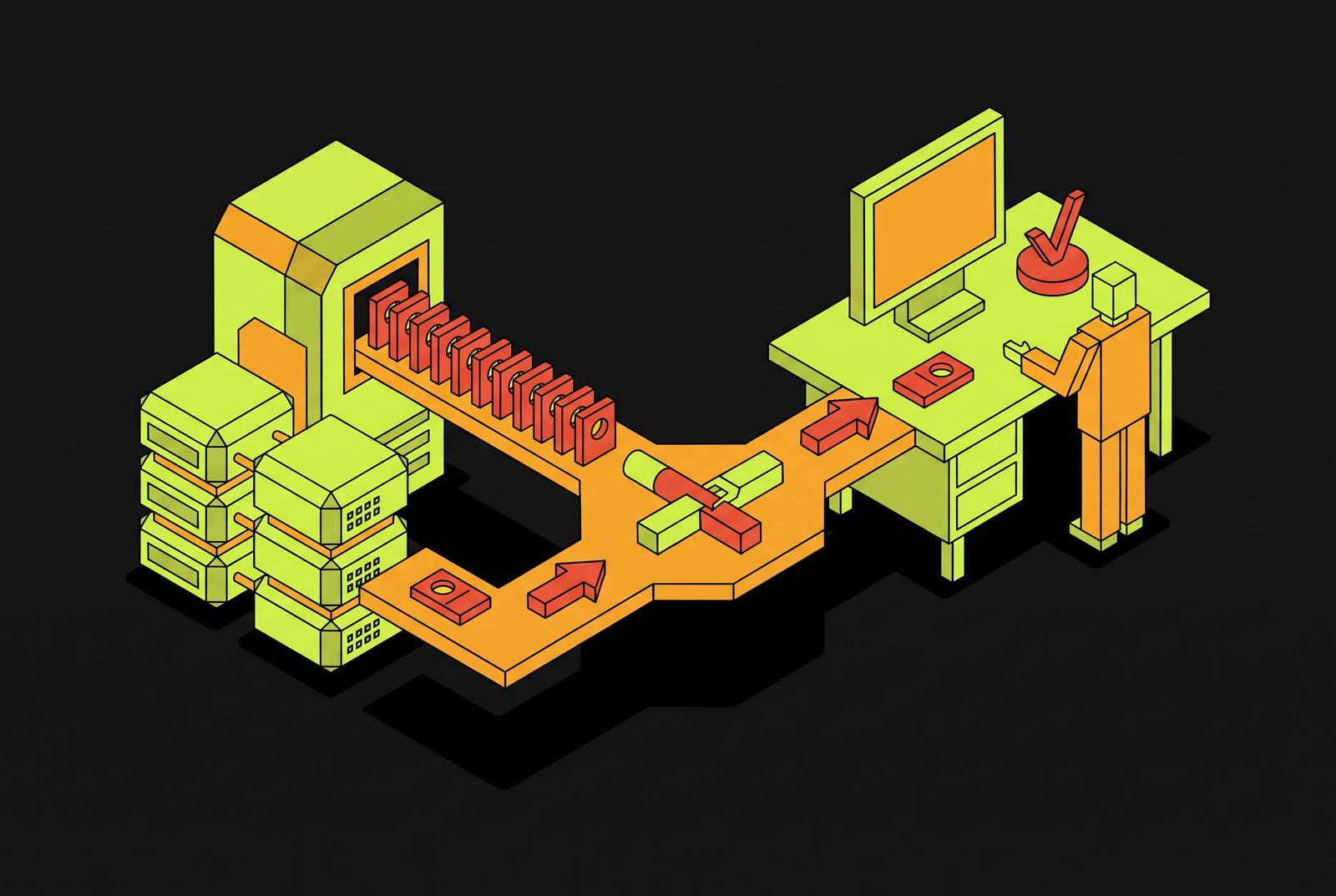
Agent handoffs between automated runs and human review work well when teams design the boundaries and avoid adding approval steps everywhere. For autonomous coding agents, Slack and Linear integration gives those boundaries a familiar review surface, while durable state preserves the work between runs. The essential design is a risk-based trigger, a reviewable context package, and an attributable decision that the next run can consume.
Why agent handoffs fail when they are treated as approval steps rather than designed boundaries
An agent returns a pull request, but the reviewer cannot tell what it tried, what it skipped, or why it chose the implementation. The diff shows the result. Before assessing the code, the engineer must reconstruct the task from logs, test output, and whatever description the agent happened to produce. Approval is available, but informed review is not. The workflow has reached a pause without establishing a usable boundary.
As review slows, more agent outputs accumulate, leaving engineers less time to inspect each one thoroughly. Adding another approval requirement does not supply the missing context. Instead, the boundary must define what the agent delivers and what decision the human is being asked to make. The design must establish what must be true at that point for an engineer to decide quickly and with sufficient evidence.
How multi-step agent error compounds and makes handoff design load-bearing
When every step must be correct for the chain to succeed, the reliability of the steps is multiplied. In a three-agent pipeline, errors at each stage can therefore make the whole run much less reliable than any single agent’s stated confidence suggests. A verbally confident answer can still be wrong, so an agent’s assurance is not an independent basis for allowing the next action.
The engineering response is to place gates around bounded, reviewable work. A human decision point gives accumulated mistakes a place to be caught before they propagate into later actions or production. Its usefulness depends on the evidence available there. An engineer who receives only the final answer still has to discover which earlier assumptions shaped it. A gate that exposes those assumptions, relevant results, and unresolved decisions gives review a concrete object.
This also changes how trigger logic is evaluated. Confidence can signal uncertainty, but a high score cannot exempt an action from review when its consequences demand approval. Risk classification and observable exceptions can each be a reason to stop. The gate is therefore a control over the proposed action, rather than a vote on whether the agent sounds credible.
What triggers a handoff: a four-tier action-risk classification
The four-tier classification starts with the consequences of acting. Read-only actions require no gate because they do not mutate the system. Reversible mutations need a light gate or a log, and external actions, including outbound communications, need a gate. A human must approve high-risk or irreversible actions. This keeps the strongest check for actions where an error could cost more than automation saves.
The action determines the tier. Security-sensitive changes, architecture decisions, and production deployments belong in the mandatory-approval tier regardless of the agent’s confidence. Mechanical, bounded, testable work, including adding tests, upgrading dependencies, fixing lint errors, and synchronizing docs, typically stays below that threshold. These tasks let agents do routine work without handing every step back to an engineer. If a proposed change crosses into a higher-risk category, however, the classification must follow the change.
A confidence threshold breach, an irreversibility flag, an anomaly, or an approaching task boundary can each prompt a handoff. Low confidence is a reason to escalate. Task boundaries let people review the decisions made so far even when no single step raises an alarm. Applying identical gate logic everywhere removes these distinctions and creates a queue in which routine approvals compete with consequential decisions for attention.
Three structural patterns for how the handoff itself is designed
An approval gate stops a proposed action until a human authorizes it. Production deployments and irreversible changes fit this pattern because permission must precede execution. The strength is a simple, auditable decision point that is hard to skip. Its weakness is throughput when applied too broadly. To work cleanly, the queue must represent structured workflow state rather than merely deliver a notification that someone might acknowledge.
Exception routing lets routine work carry on and sends the cases that meet its rules to a reviewer. In a larger autonomous run, an unexpected state or threshold breach can trigger escalation without requiring approval for every completed step. The trigger conditions need careful definition and testing. A threshold that fires too often recreates the approval bottleneck, while one that fires too rarely misses the cases the pattern exists to expose.
A collaborative checkpoint lets the agent and human work with the same shared state. The agent writes to a staging area, the human reviews and signals, and the agent resumes. File-based workflows use directory states such as raw, needs_review, approved, and rejected to track this. The pattern suits long-running work that people can usefully review in parts, and it also fits pull request review. Shared state must be managed with idempotency controls because concurrent writes can corrupt the handoff object.
These patterns complement one another within the same workflow. Collaborative checkpoints support bounded implementation tasks, exception routing supports larger autonomous runs, and approval gates protect deployments and irreversible changes. The choice follows the kind of decision required at each boundary. There is no need to impose one interaction model on every task.
How do Slack and Linear support async handoffs when synchronous approval breaks?
Synchronous approval ties a human decision to an open connection. That is a poor fit for review that may not happen while the original run remains active. Even correct trigger logic cannot remove this dependency. Roughly two-thirds of production agents already tolerate minute-plus latency, which makes asynchronous interaction a practical production default.
The agent writes its output and context package to a durable state store, emits a Slack message, Linear comment, or GitHub pull request, and terminates cleanly. The human reviews the saved work and signals a decision. A new agent run then resumes from stored state. The notification points to the boundary, while the durable record preserves what the next run needs.
Resume behavior needs protection against repeated execution. Idempotency keys keep a resumed run from doing finished steps again, which could repeat actions or cause conflicting mutations. An isolated, sandboxed environment also makes it easier to capture the agent’s state at handoff, rather than depend on reconstructing ephemeral local context. Capturing that state supports a deterministic resume. Isolation alone does not replace the durable handoff record or controls on repeated actions.
Slack and Linear are useful here because they bring review requests into workflows engineers already use. For teams evaluating integration with autonomous coding agents, the relevant distinction is therefore between a message that merely announces completion and one connected to a durable, resumable handoff.
What context the agent must surface at the boundary for review to be fast and trustworthy
The handoff package must answer what changed, why it changed, and what remains unresolved. A plain-language summary establishes what the agent completed, while a decision trail explains the options considered and why one was chosen. Failed attempts belong there when they explain the final choice or a remaining limitation. The reviewer also needs unfinished work and its reasons. Anomalies and uncertainty must be visible in the handoff package.
For coding work, the pull request is the natural primary artifact. Its description needs to say what the agent did, which tests it ran, and where it remains uncertain. A diff without that structure leaves too much reconstruction to the reviewer. Test results and logs should be available in a form that can be scanned. The goal is to reduce cognitive load without hiding the evidence needed to challenge the summary.
Agentic Electronic Design Automation: A Handoff Perspective organizes handoff objects into primary, supporting, and intermediate categories. For coding agents, the primary output is the artifact being reviewed, and the supporting material includes both the inputs and the outputs from checks. Constraints, references, and knowledge sources show what the task is based on, and test results and reports help reviewers judge whether the result meets those requirements. Intermediate artifacts include checkpoints, plans, and logs. All three categories need to be present and mutually consistent so that the reviewer can connect the task’s constraints to the result.
An execution recording shows what the agent did step by step, allowing review of the process as well as the final change. This is especially useful for long-running or multi-step tasks whose output does not reveal how it was reached. A reviewer can use the structured account to locate the decision that needs closer inspection, then audit the execution behind it.
How output format determines whether the handoff serves the human or the next agent run
The same handoff must support two different readers. The engineer needs a concise explanation and accessible evidence, while the resumed pipeline needs stable fields it can consume without interpretation. Ad-hoc prose may appear readable but forces downstream systems to parse a structure that can change between runs. Machine-only output creates the opposite problem, making the human decode the state before reviewing the decision. The boundary therefore needs an API contract with a human-readable layer.
JSON suits machine consumption, markdown suits structured human-readable content, and HTML suits browser or email rendering. A decision trail can use markdown, artifact metadata can use JSON, and resume state can follow a typed schema. The format follows the consumer’s job. A readable summary can wrap structured data without making that data depend on the wording of the summary.
Output structure should be specified in the agent’s task definition. Leaving it to the model’s default response style turns every downstream consumer into a parser of variable prose. Across multi-agent runs, those extra parsing steps compound fragility because an oddly formatted response can interrupt later work. Sticking to a schema keeps the handoff stable enough for automation and keeps the explanation people need to judge the work.
Attribution and analytics as the infrastructure that makes handoffs auditable at scale
A reviewable handoff still needs a traceable origin. Each run, trigger, review decision, and outcome must be attributable to its source, model, and task. Full run-level attribution includes the source, harness, model, credential, and duration. Without that record, a slow review queue cannot be reliably separated into excessive escalation, insufficient context, or lower-quality agent output. These are different faults and call for different changes.
The useful metrics connect agent activity to review and shipping. Agent-assisted pull request share links runs to the work being shipped, and reviewer turnaround time by handoff type helps show whether context packages let people make decisions quickly. Escalation rate by task category exposes possible trigger-calibration problems. Retained weekly active agent users show whether people keep using agents after trying them at launch. None of these signals should be interpreted without the task and run information that explains them.
A high handoff rate may reflect a miscalibrated threshold or identify work that genuinely straddles a boundary and needs a different pattern. Teams using Claude Code, Codex, Cursor, or Opencode need harness-agnostic attribution to compare agents on the same task class. That comparison can guide future routing toward agents whose handoffs reviewers trust most. Measurement gives teams a way to revise specific boundaries as evidence accumulates, rather than responding to every workflow problem with another approval step.