Coding Agent GitHub Actions Integration for Autonomous PRs
Autonomous coding agents need infrastructure planning, not just configuration choices.
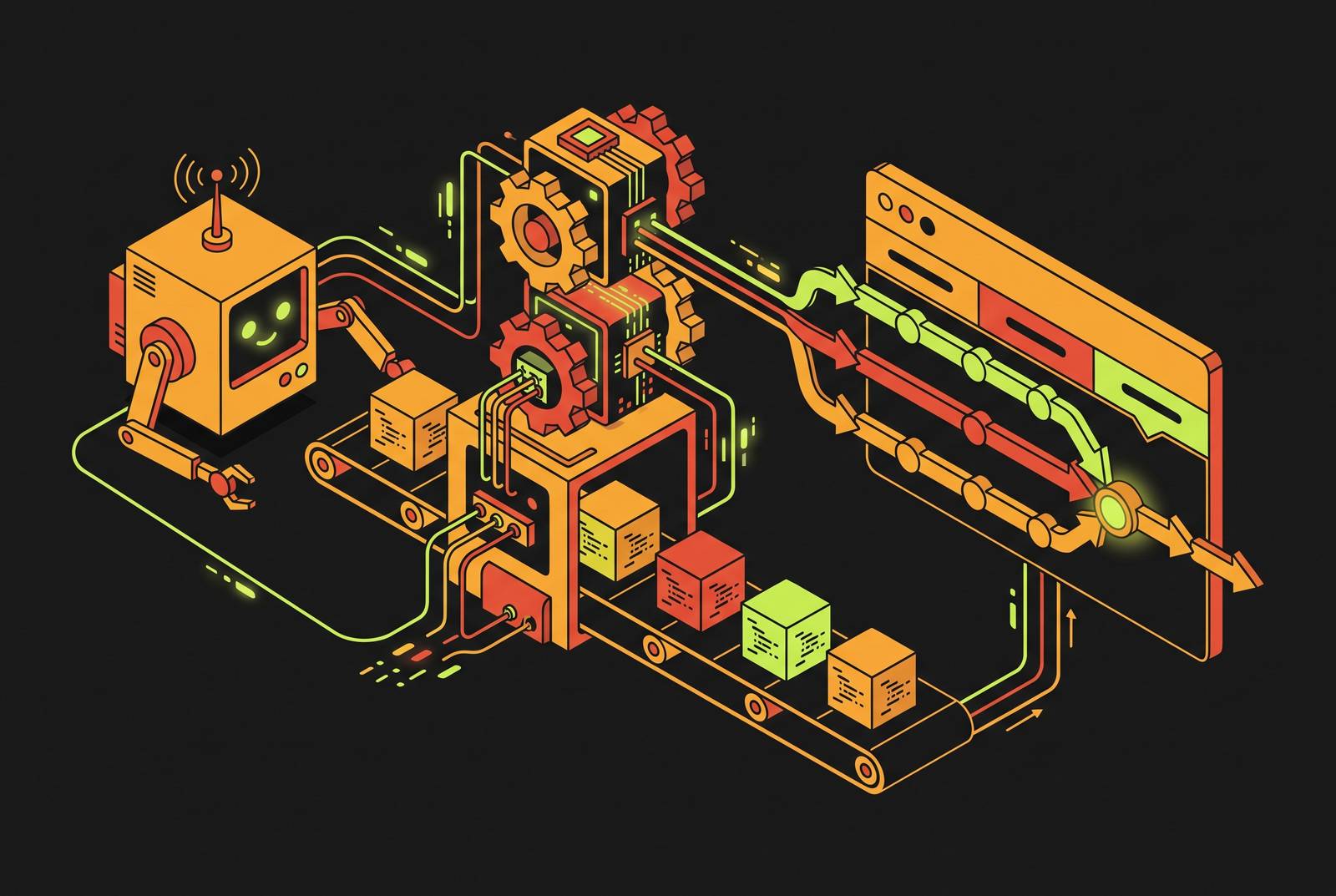
Replicas lets teams trigger Claude Code or Codex from Linear tickets or Slack messages and run each task in an isolated Linux VM. For autonomous PRs, GitHub Actions integration connects that incoming work to a configured environment, an agent, and the existing review pipeline. Infrastructure does more than prompt writing to give a background worker a reliable path from a request to a change that can be reviewed.
Why wiring a coding agent to GitHub Actions is an infrastructure decision, not a configuration step
An AI coding assistant suggests completions when asked. A coding agent takes responsibility for a longer sequence, planning tasks, editing files across a codebase, running tests, managing git workflows, and submitting pull requests with minimal human direction. That broader remit makes its execution environment and permissions part of the engineering system. Every agent-authored PR still passes through the same build and test pipeline as a human-authored one. There is no shortcut around the repository’s requirements simply because the author can work unattended.
What a GitHub Actions-powered coding agent workflow actually looks like end to end
The autonomous PR workflow has six steps, which are trigger, provision sandbox, read codebase and plan, implement and verify, open PR, and iterate on review feedback. First, a developer or automated system assigns work through an issue assignee, an @-mention, or a programmatic trigger. The input is a plain-language description of the desired outcome. Its quality directly shapes the output because it defines what the agent is being asked to accomplish.
Second, GitHub Actions provisions a sandboxed runner with the repository’s development environment. An optional setup file supplies the tools and dependencies the agent needs before it begins. Third, the agent reads the issue and examines relevant files, dependencies, tests, and project structure to form an implementation plan. Fourth, it edits the code, runs linters and tests, and fixes failures. Provisioning and verification are distinct steps, but verification depends on the environment being capable of running the project correctly.
Fifth, the agent opens a draft or ready-for-review PR containing the changes and a summary of its decisions. Sixth, developers review the result, leave comments, and the agent iterates. The cadence of that loop matters when choosing where to use autonomy. Background agents such as the Copilot coding agent operate on an hours-long assign, PR, and review loop, while interactive agents such as Claude Code support a seconds-long describe, execute, and adjust loop. Both patterns are useful, but they serve different jobs.
How the main agents differ in their GitHub Actions integration depth
Integration depth describes how much of that workflow an agent can carry without human handoff. Copilot’s coding agent follows the issue-to-PR pattern, with GitHub at the core of how it sets up the environment and shares its work for review. It requires a Copilot Pro, Pro+, Max, Business, or Enterprise subscription, which excludes the free plan.
Claude Code enters GitHub through the Claude Code GitHub Action. A mention of @claude in an issue or PR comment lets it read the issue, write changes, and push commits in the workflow already in place. Its 33 hook events and Dynamic Workflows provide a customizable event surface. The practitioner distinction in the notes concerns autonomy as well as integration, with Claude Code taking initiative through tests and failures while Codex tends to complete a section of work and check in before continuing. That difference affects how much supervision a task requires, with implications for agent choice that are task-specific.
Cursor’s full product is tied to a VS Code fork, while terminal agents are editor-agnostic. OpenCode has a different way to plug into the workflow: a headless server with a permissive license that works with multiple model providers and can be run from CI. Its quality depends on the selected model, with no bundled model or first-party benchmark. For teams that want agent choice above a shared execution layer, Replicas supports Claude Code, Codex, Cursor, and Opencode in isolated Linux environments, switchable by task. That arrangement separates the choice of worker from the infrastructure used to run it.
Configuring the sandbox environment the agent runs in
For the Copilot coding agent, the primary configuration lever is copilot-setup-steps.yml in the .github/ directory. It controls which tools, runtimes, and dependencies are installed before work begins. Without it, the agent falls back to a default environment and may fail silently on complex builds. The setup file is therefore part of the task’s execution contract. It establishes what the agent can assume is available, rather than leaving those assumptions to emerge during implementation.
Provisioning can also sit outside repository-specific Actions setup steps. In Replicas, each task runs in a pre-configured Linux VM loaded with the team’s codebase and dependencies, where the agent can install packages, run services, and verify changes. GitHub Agentic Workflows added Docker Sandboxes as a supported runtime in July 2026. That runtime allows broad control inside a microVM with its own kernel, filesystem, network stack, and private Docker daemon, without giving the agent control of the host’s Docker daemon. The distinction is between authority inside the workspace and authority over the host.
GitHub Agentic Workflows also use read-only agent access by default, with writes passing through configured safe outputs such as pull requests, issue comments, and labels. A useful credential pattern separates the model client from the tools it invokes. The process that talks to the model API holds the key outside the sandbox, while shell commands, tests, file edits, and package operations run inside the restricted environment.
For GitHub access, a GitHub App installation token or a fine-grained token limited to one repository and specific permissions is preferable to a classic PAT. The security checklist starts with a sandbox that contains no host secrets and a read-only repository mount with one writable output directory. Network access should be offline or pass through an allowlist proxy. Credentials should be short-lived and scoped to a dedicated agent identity. The job that reads untrusted content should have no write access.
How can teams trigger autonomous coding agents from Slack messages and Linear tickets?
How teams trigger work shapes whether engineers can hand it off through tools they already use or have to remember another interface. With Replicas, a team can ping it from a Slack channel to start work, and it reads the ticket, gathers context, and begins implementation. Agent runs can also originate in Linear, GitHub, GitLab, or the Replicas dashboard. The result, whether a PR, recording, or reply, returns to where the team already operates. That extends the entry points without changing the review workflow.
Linear’s official integrations page also lists Codex, Cursor, and GitHub Copilot as delegatable agents. The useful comparison is therefore not simply whether a product connects to Linear. It is which agents the integration can delegate to, where those agents execute, and where their output returns. A ticket integration is where work comes in, while the sandbox and PR pipeline control what happens after it is handed off.
GitHub-native triggers remain useful when the work already lives in the repository. An issue assignment or comment mention can start a task without moving its description elsewhere. For automation, GitHub Actions provides workflow_dispatch, schedule, and repository_dispatch events for scripts, CI pipelines, and external systems. These support recurring work such as dependency upgrades, test generation, and documentation updates. The principle is to accept work where it originates while preserving a consistent execution and review path.
What the PR output needs to look like for review to stay manageable
Once agents can make changes unattended, the review queue limits how much work can move through. A PR must communicate whether the work is still in progress or ready for a reviewer’s attention. Copilot makes draft versus ready-for-review output configurable, so that choice should match the team’s expectations. Draft output lets the team see work as it happens, while ready-for-review output fits issues the team has high confidence in. Treating those states as interchangeable shifts uncertainty onto the reviewer.
The PR summary must explain the decisions behind the change. Copilot and Claude Code can provide full summaries, reducing the amount of reasoning a reviewer must reconstruct. Scope matters for the same reason, since changes across many files give a reviewer more to keep track of. Well-specified issues constrain that scope before implementation starts. Output design therefore begins with the request rather than with the text generated when the PR opens.
Copilot’s workflow includes CodeQL analysis, secret scanning, and dependency review, so the PR arrives pre-screened for those checks rather than leaving them entirely to manual inspection. Linear’s Tom Moor reports that over 50% of PRs generated by its coding agent are mergeable, making the agent one of Linear’s top contributors. The bottleneck shifted toward context quality, prompting Linear to write more RFCs and reduce token usage through context engineering. How smoothly review goes thus depends on choices made earlier, including a clear issue and a sandbox where the agent can check its work.
Analytics and attribution: knowing what each agent run actually produced
Higher PR volume does not by itself establish that autonomous work is helping the team. Once several agents are running, measurement needs to distinguish the agent, model, trigger, and task type behind each result. Without that attribution, teams cannot meaningfully optimize the workflow, budget for it, or justify the investment. A count of generated PRs records activity but not what became useful code.
DORA metrics are still the baseline for measuring how much engineers get done, but teams need more signals for agent workflows. Those signals include which PRs came from agents, which merged, which required rework, and how their cycle time compared with human-authored PRs. Replicas provides attribution down to the source, harness, model, and credential for every minute an agent runs. That per-run visibility supports comparisons between Claude Code and Codex on the same task type, or between trigger sources by merge rate.
Keeping the workflow harness-agnostic as models and agents change
The fastest-moving variable in this workflow is the model beneath the agent. Binding the trigger, environment, and PR process to one agent makes those more stable parts depend on a changing choice. Harness-agnostic infrastructure keeps them separate so that agent and model selections can change independently. It also accommodates mixed-provider work, including expensive models for planning, cheaper models for parallel execution, and cross-provider review. The latter avoids asking a model family to review its own output and repeat its blind spots.
OpenCode’s headless, CI-drivable design expresses this separation at the agent level. At the platform level, the same Replicas integrations can delegate tasks to Claude Code, Codex, Cursor, or Opencode without changing the underlying infrastructure. The practical recommendation is to build the trigger, sandbox, and PR output pattern to be agent-independent from the start. The agent that produces the best PR today may not be the right choice for the same task type in six months. Infrastructure turns an AI tool into a background worker, and the infrastructure that lasts is designed to outlive any single model.