When to Run Multiple Coding Agents in Parallel
Parallel agents pay off only for separable tasks and isolated environments.
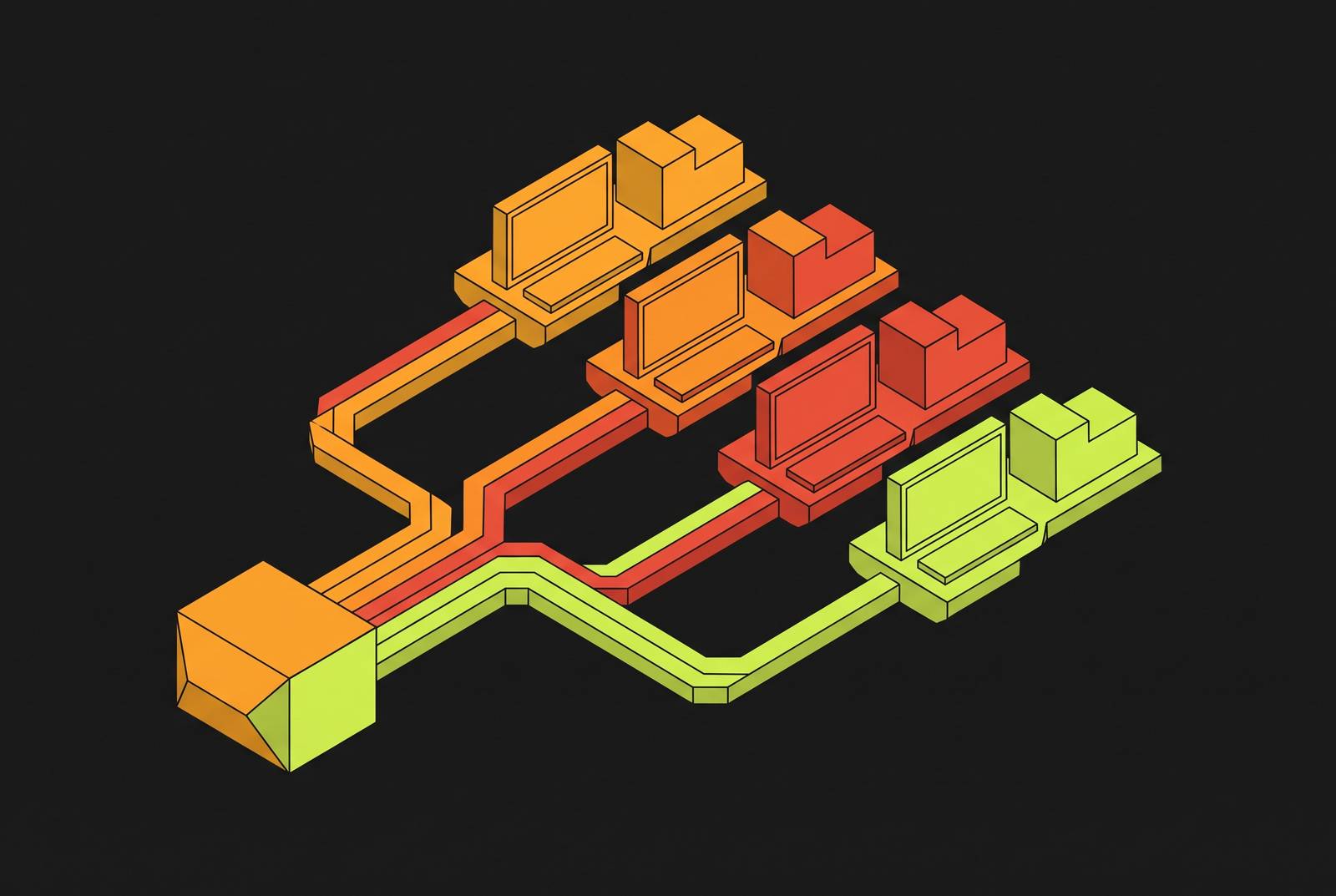
Running several coding agents at once is becoming normal practice among engineering teams, but the gains only materialize under specific conditions: the work has to be genuinely separable, and the environment has to keep each agent from stepping on the others. A team's real challenge isn't whether to parallelize coding agents but which tasks, which repo setups, and which infrastructure choices make that parallelization pay off rather than pile up review debt.
How parallelizing coding agents becomes a team's default mode
Nobody sits down and decides to run four coding agents at once as a matter of policy. It starts smaller than that: an engineer opens a Claude Code session, watches it churn through a task, and instead of sitting idle for the next few minutes, opens a second terminal to start something else. Then a third. Then a fourth. What begins as a way to fill dead time while one agent works hardens, session by session, into a standing habit. Some engineers run several sessions against the same repository. Others check out multiple copies of it, or use separate git worktrees, whichever setup keeps two agents from editing the same files at the same moment. The mechanics vary, but the path to get there is the same: nobody plans it, it just stops making sense to wait around.
Why code generation is no longer the bottleneck
Once an agent can write code faster than any human typing by hand, the thing holding a team back is no longer code generation but whatever happens after the code exists: the human attention needed to track what's running and the review capacity needed to check it. Running more sessions creates two problems that used to be one. First, an engineer managing four concurrent agents has to hold four separate mental models at once: what was asked of each one, what each has produced so far, and what each still needs a decision on. Second, and more stubborn: more output from agents running in parallel doesn't mean more scrutiny gets applied to that output. One person still has one set of eyes. Simon Willison has made the point: you can parallelize the work itself faster than you can parallelize your own attention, so even someone running several sessions can still only focus on reviewing and landing one significant change at a time. That means the actual time cost of running agents in parallel appears at the merge and integration stage, not during code generation. Work generated by AI agents tends to carry more issues and merge at a meaningfully lower rate than work written by hand. The more parallel output a team generates, the more review it owes, not less. Parallelizing the wrong kind of task, or parallelizing without the infrastructure to support it, adds review debt faster than it saves implementation time.
Task shapes that parallelize well
The test that decides whether a task is safe to parallelize is independence: does it share state with anything else running at the same time? A task with no collision surface, nothing another agent might also be touching, can run alongside other work without needing coordination that eats into the time saved. Some shapes meet that bar cleanly. Independent modules or microservices that don't share state are a natural fit. Separate repositories are isolated by definition. Boilerplate and scaffolding work is low-risk and mechanical, easy to check quickly once it's done. Generating tests for code that already exists works well too, since the agent only reads production logic to produce them. Refactors scoped tightly to a single file or class also parallelize cleanly, because the blast radius stays contained.
Other shapes look parallelizable but end up costing more than they save. Anything touching a shared module, authentication, billing, the core data models, risks two agents editing the same file or interface and producing conflicts that need to be resolved by hand before either branch can merge. Tasks with scope that's still vague tend to stall mid-run when the agent hits a question it can't resolve on its own, which pulls a human's attention right back to that stream regardless of how many others are running. Tasks where one agent's output feeds directly into another's input cause trouble unless the sequencing between them is enforced somewhere concrete. Before spinning up a second session, the practical test is simple: can both tasks merge to main independently, without either one touching the same file, interface, or data structure? If the answer is yes, run them in parallel. If not, sequence the work or split it by hand first. David Heinemeier Hansson, chief technology officer at 37signals, works this way at scale: the same independence principle that governs a single engineer's decision to split two tasks across two terminals governs how an entire team decides which pieces of a codebase can move at once without engineers getting in each other's way.
Structured context-switching keeps parallel streams from collapsing into each other
Standard advice for sustained programming work says to minimize context switching, since every switch costs focus. Parallel agent work runs against that rule directly: it requires switching on purpose, often several times an hour, because that's how an engineer checks in on sessions that are all moving at once. The cost of each switch still slows the engineer down, so the switching has to be structured rather than reactive, and engineers who manage several agents well tend to treat each one as a labeled thread: its own branch, a scope defined before the session starts, and a clear connection to a specific outcome. They work through a short list of active threads in order, rather than jumping to whichever terminal happens to show new output first.
A few habits make that discipline stick. Giving each stream its own branch, worktree, and written scope before the agent starts, not after, keeps the work from drifting. A short spec or task description that the agent reads as its ground truth prevents the kind of mid-run ambiguity that pulls an engineer back in at the worst possible moment. Defining a clear way for each stream to check its own work, a test that has to pass, a build that has to succeed, a screenshot to compare against, lets the agent catch its own mistakes before a human ever needs to look. Running the same automated checks across every parallel stream, consistently, catches errors that one engineer tracking several sessions by memory would miss. Sid Bidasaria, an engineer at Anthropic, has described running several agents at once and finding that it made him noticeably more productive, with a few agents running throughout his day becoming a steady source of output. But gains like that only hold if review keeps pace with the agents producing the work. No amount of discipline changes the fact that one person still reviews sequentially, and that sequence, not the number of agents running, sets the actual rate at which work gets merged.
Isolating each agent's environment, not just its branch
Git worktrees give each agent its own checkout, solving filesystem collisions so two sessions can't overwrite each other's edits, and each stream merges like any ordinary branch. That's the minimum requirement, but it isn't the whole requirement. The moment an agent installs a package, starts a service, drives a browser, or calls an external API, branch isolation stops being enough, because those actions touch compute, not just files. Standard containers share the host's kernel, so a vulnerability or a runaway process inside one agent's session can, in principle, reach the host machine or another session running alongside it. Most development environments were built with a single human opening one pull request at a time in mind, not dozens of agents running concurrently, each needing a sandbox of its own.
Three approaches to compute isolation are in active use to close that gap. MicroVMs, built on technology like Firecracker, along with orchestration frameworks like Kata Containers, give each sandbox its own kernel and its own network namespace, so a vulnerability in the guest kernel has no path to the host. gVisor takes a different approach: a user-space kernel that intercepts system calls without the overhead of running a full virtual machine. Hardened containers sit a step below both: tighter than a default container setup, still sharing the host kernel, and appropriate for workloads that carry lower risk. Whichever approach a team picks, a properly built environment for a single agent needs its own kernel or kernel namespace so actions in one session can't bleed into another, dependencies pre-loaded to match what the team actually uses so the agent isn't wasting a run on environment setup, fast enough spin-up and teardown that creating a new environment per task doesn't become its own overhead, and network controls that define what the agent is allowed to reach.
How harness and model choice interact with parallel workloads
The harness, the layer of scaffolding wrapped around the underlying model, matters as much as the model itself once work is running in parallel, because harnesses differ in how they provision environments, handle concurrency, and manage tasks that run asynchronously. Claude Code draws a clear line between subagents working within a single session, background agents running as many independent sessions at once, and agent teams, where multiple sessions coordinate automatically with shared tasks, messaging, and a lead agent directing the work. Its context window is large enough to suit complex refactors that touch many files and need deep understanding of the codebase, though token usage per task runs higher, a real cost when many sessions are running at the same time.
Codex is built with parallel, asynchronous execution as the default case: it spins up short-lived cloud containers using microVMs, clones the repository, runs the assigned task, and sends back a pull request without needing supervision along the way. It uses git worktrees to queue multiple tasks in parallel with a reduced chance of file conflicts, though conflicts can still surface once everything comes together at merge time. It fits best with tasks that are well-defined enough to dispatch and leave alone, rather than tasks that need a human checking in as they go. Opencode takes a different path: open-source, local-first, giving teams control over which provider and model they use. Its plan and build agents keep read-only planning separate from the steps that actually change code, suiting teams with data-sovereignty requirements or teams that want to bring their own model provider.
The strongest pattern in practice is matching the task to the tool: using Claude Code for planning and for complex, multi-file refactors where deep codebase understanding matters, and using Codex for parallel test writing and fast, well-defined code generation. A team locked into a single harness can only run the parallel patterns that harness happens to support. Staying able to route different tasks to whichever harness fits them keeps that option open as better models and better harnesses continue to ship.
Analytics teams need to manage parallel agent work across the team
The attention problem that affects one engineer running four sessions turns into a management problem once a whole team is running agents in parallel. Without attribution down to the specific source, harness, model, and credential behind every agent run, an engineering leader cannot tell which parallel work is actually shipping, which has stalled, and which is quietly generating more review debt than it resolves. The metrics that matter here are pull request acceptance rates and review cycle times, because parallel agents multiply output faster than any team's review capacity grows, and that gap appears as a pile of pull requests that were opened but never merged.
Work generated by AI agents merges at a notably lower rate than work written by hand, and pull requests with AI assistance tend to run larger, though fully agentic pull requests, where the agent handles the full task end to end, actually tend to be smaller and more tightly scoped than human-authored ones. Running more parallel sessions without better review tooling in place doesn't raise throughput. It builds a backlog. Useful analytics for this kind of work need to show active agent sessions broken down by team and task, so leaders can see how much is running concurrently in real time rather than guessing based on pull request volume after the fact. They need attribution by harness and model, so a team can tell whether its Claude Code sessions or its Codex sessions are producing stronger pull requests for a given kind of task. They need time-to-merge tracked by stream, to separate cases where review is the actual bottleneck from cases where the agent itself has stalled mid-task. And they need attribution down to the credential level, so cost and output both trace back to the specific runs that produced them. Automated checks applied consistently across every parallel stream, not an individual engineer's ability to track five sessions by memory, are what keep quality from slipping as the number of sessions running at once grows.
Routing parallel agent work through the tools teams already use
Any setup that forces an engineer to leave the tools already in daily use just to start or check on an agent session adds a tax on every single session, and that tax compounds as the number of sessions grows. It costs almost nothing when there's one agent running. It costs a great deal when there are ten. The integration pattern that avoids this problem triggers agents directly from Slack, from Linear, or from GitHub or GitLab, rather than from some separate console built just for managing agents, and sends results back to wherever the task started: a pull request, a recording, a summary landing in the same thread or the same ticket that kicked the work off.
Making that work requires a few specific things. Triggers need to fire from issue trackers like Linear or GitHub Issues and from messaging tools like Slack, without asking the engineer to leave the context they're already working in. Output needs to land in the same place the task was assigned, a pull request opened against the correct repository, a reply posted in the correct thread, so review becomes a natural next step. And attribution needs to connect every run back to whatever triggered it, so a team can always trace what was asked against what actually got delivered. That's the shape parallelization takes once it moves from an individual habit into how a whole team operates: any engineer can hand off a well-scoped task from wherever they already work, the agent runs inside its own isolated environment, and the result comes back as something ready to review, without changing a single thing about how the team works day to day.