Coding Agent Harness Selection Criteria for CTOs
A repeatable framework for choosing coding agent harnesses.
When you pick a coding agent harness, you decide how work gets delegated, checked, and controlled across your team. It is not a one-time ranking exercise where a CTO picks the tool with the highest score and moves on. The distinction between a model and a harness matters here: a harness is the runtime system that sits around a model, handling the agent loop, the tool and file operations, the context window, and what happens when something breaks. Swapping the same model between two harnesses changes the file-reading strategy, the tool schema, the retry policy, and the approval flow, even though the model underneath is identical. That single fact explains why model leaderboards cannot settle a harness decision: ranking models is not the same exercise as ranking harnesses, and treating them as interchangeable questions leads teams to compare the wrong thing.
The production stack most engineering organizations run in 2026 has three layers: an IDE for real-time collaboration, a CLI for local execution, and cloud agents for asynchronous delegation. Harness selection governs that third layer, and that third layer is where bounded, testable, reviewable work piles up at scale, things like dependency upgrades, lint fixes, and test coverage additions that don't need a developer watching in real time. No harness wins at everything, so most mature teams end up running two or three at once, routed by the kind of work being delegated, not by loyalty to one vendor. That outcome means a CTO needs a repeatable evaluation framework, not a list with a winner circled at the top.
The Five Jobs a Harness Controls
A model generates text. It can't read files, run shell commands, decide when to ask permission, or remember what happened three turns back. The harness handles those functions, and it does five jobs the model can't do on its own. How well a harness performs each one is what a CTO is actually sizing up when comparing options, whatever the comparison looks like on the surface.
The first job is context assembly: deciding which files and which prior turns actually get sent to the model, and managing that selection as a task grows past the point where everything fits. The third is permission gating, the harness's security posture made concrete: whether a destructive command executes immediately, pauses for approval, or gets refused. The fourth is recovery behavior, what the harness does when a patch fails to apply or a test turns red, whether it retries, escalates to a human, or simply stops. The fifth is session state: whether an interrupted run can pick back up where it left off or has to start over from nothing.
An empirical loop test makes the stakes concrete. Where they diverged was in the loop itself: whether the harness ran the test suite before declaring the task done, whether it caught a dead import left behind in the patch, and whether it verified the patch's logic before handing it back. None of the six verified their own patch logic, so patch verification is still an open problem across the industry, not a feature some harnesses have solved and others haven't. That finding is the clearest evidence available that the five jobs above, not raw model quality, are where harnesses actually separate from one another. A harness that catches a dead import and one that doesn't are running the identical model and producing different outcomes, because the difference lives in the loop, not in the weights.
Task fit: matching the harness to the type of work being delegated
Task type is the first filter that should shape a routing decision, ahead of cost, model choice, or any integration question. Harnesses often spread wider across categories of work than they do within one category, so if you assign the wrong harness to a task type, it costs you more than picking a marginally weaker harness for the right one.
The documented design intent of individual harnesses bears this out. Neither harness is weaker than the other in any absolute sense; each was built around a different interaction model, and each performs best on the task type its design was built to serve.
Routing has to be decided before the harness is chosen. If a CTO evaluates harnesses without first mapping the team's actual task distribution, what share of delegated work is bug fixes versus feature additions versus documentation versus migrations, they are comparing tools against an undefined target. Knowing which is which, for your own team's work, is a prerequisite for the rest of the evaluation.
Model portability: why the ability to swap models is a strategic criterion, not a preference
Locking a harness to one model family means falling behind every time a better model ships for a specific kind of task, and given how fast model leadership has been moving, that is an operational risk a team will run into, not a hypothetical worth discussing in the abstract.
The binary that actually matters here is simple: either the harness reads a base URL from a config file and treats the model as a swappable setting, or the model menu is owned by the vendor and the team's choices end there. GitHub Copilot allows the chat model to be switched natively, and the inline completion model can also be switched, but the two are handled through separate settings. Claude Code allows model swapping through the ANTHROPIC_BASE_URL environment variable, and Codex allows it through a --model flag, a config.toml entry, or a /model command, though custom providers used this way need to support the Responses API format.
On OpenRouter, the most-used model running inside Claude Code is not one of Anthropic's own, with usage spread across multiple providers instead, while Codex's top-ten traffic stays concentrated almost entirely within OpenAI's own model family. That pattern shows that developers on model-flexible harnesses already treat model selection as its own decision, separate from the choice of harness itself. Benchmark scores like those published on public coding and agentic-task benchmarks are snapshots in time: vendors report them for the models they're measuring, tied to a specific model version that will be superseded. A harness that locks a team into one model family is a bet that today's ranking holds steady in a field that has shown no sign of holding still.
Sandbox integrity: what "isolated execution" requires in a production environment
The environment an agent executes in matters as much as the model generating its instructions, and the word "sandboxed" covers a wide range of actual guarantees, not one fixed standard. Treating it as a checkbox rather than a spectrum is where teams get into trouble after the fact.
Four things need to be true of a production-grade sandbox. Resource limits on memory and CPU need to be enforced, so a runaway task doesn't degrade performance for every other task sharing infrastructure. Every tool call, file write, and shell command needs to be logged and attributable to a specific run.
Harnesses approach this differently, with structural differences in how they enforce it. Google Antigravity uses nsjail on Linux, sandbox-exec on macOS, and AppContainer on Windows, a genuinely sandboxed execution model built into the harness itself.
Whether an environment should be ephemeral or persistent is a real engineering decision that depends on the task, not a default setting to accept blindly. Sandbox integrity also doesn't cover the security posture of the code an agent produces. A significant share of AI-generated code contains known classes of vulnerability, so SAST and SCA tooling in the pull request workflow, along with human review of security-critical paths, are required regardless of how well the sandbox contained the execution itself.
Cost observability: measuring agent spend and output
At team scale, the unit that shows up on an invoice and actually connects spend to output is cost per successful task, not cost per run. A harness that looks cheapest on a rate card can turn out to be the most expensive option once its success rate is factored in, because every failed run still consumes tokens and compute without producing anything a team can ship.
Context management is one of the clearest levers on cost. Gartner lists usage analytics and reporting on agent usage and impact across users and projects among the mandatory enterprise features for cost observability, and that requirement points at a real operational gap: a team that cannot see usage broken down by user and project cannot tell which workflows are generating value and which are generating token spend with nothing to show for it.
A small set of metrics makes this measurable in practice. Pull request throughput, tracked as PRs per week, broken down by harness and task type, shows which combinations are actually producing shippable work. Time from issue assignment to PR submission shows you how long delegation actually takes end to end. Attribution across these metrics matters for more than billing. A team that cannot attribute output to a specific harness, model, and task type has no evidence base for making a routing decision, leaving routing to rely on impressions.
Workflow integration: how a harness connects to where engineering work already lives
A harness that forces engineers to abandon Slack, Linear, GitHub, or GitLab in favor of a new interface gets adopted unevenly across a team, and that uneven adoption produces exactly the attribution gaps and routing inconsistencies that make every other criterion in this framework harder to measure cleanly.
Gartner's list of mandatory enterprise features for integration names extensible tool and environment integration, meaning configurable connections to IDEs, command-line interfaces, build systems, dependency managers, and CI/CD pipelines, as a baseline requirement. Alongside those, Gartner lists enterprise controls covering user and access management, organizational configuration, and a guarantee that base models will not be trained on customer code or documentation except where fine-tuning or customization has been explicitly approved.
Where a harness lives determines how it can be triggered. Terminal-first harnesses, among them Claude Code, Codex CLI, and Opencode, can be piped, scheduled with cron, or run over SSH, which makes them well suited to automation and to CI/CD pipelines where no human needs to be watching. Editor-first harnesses, Cursor and Copilot among them, keep the agent inside the editing surface itself, which suits developers who want to see and accept a change in context but fits less naturally into background delegation. Across all of these, background agents that return pull requests into an existing review workflow add more value for team-wide adoption than interactive copilots do, because they hand output back into the process engineers already use. MCP interoperability is emerging as the shared standard across this landscape: a harness that supports MCP servers can connect to any tool that publishes an MCP interface, which keeps integrations working as the surrounding tool ecosystem keeps expanding.
Applying the framework: how to run a harness evaluation that produces a routing decision
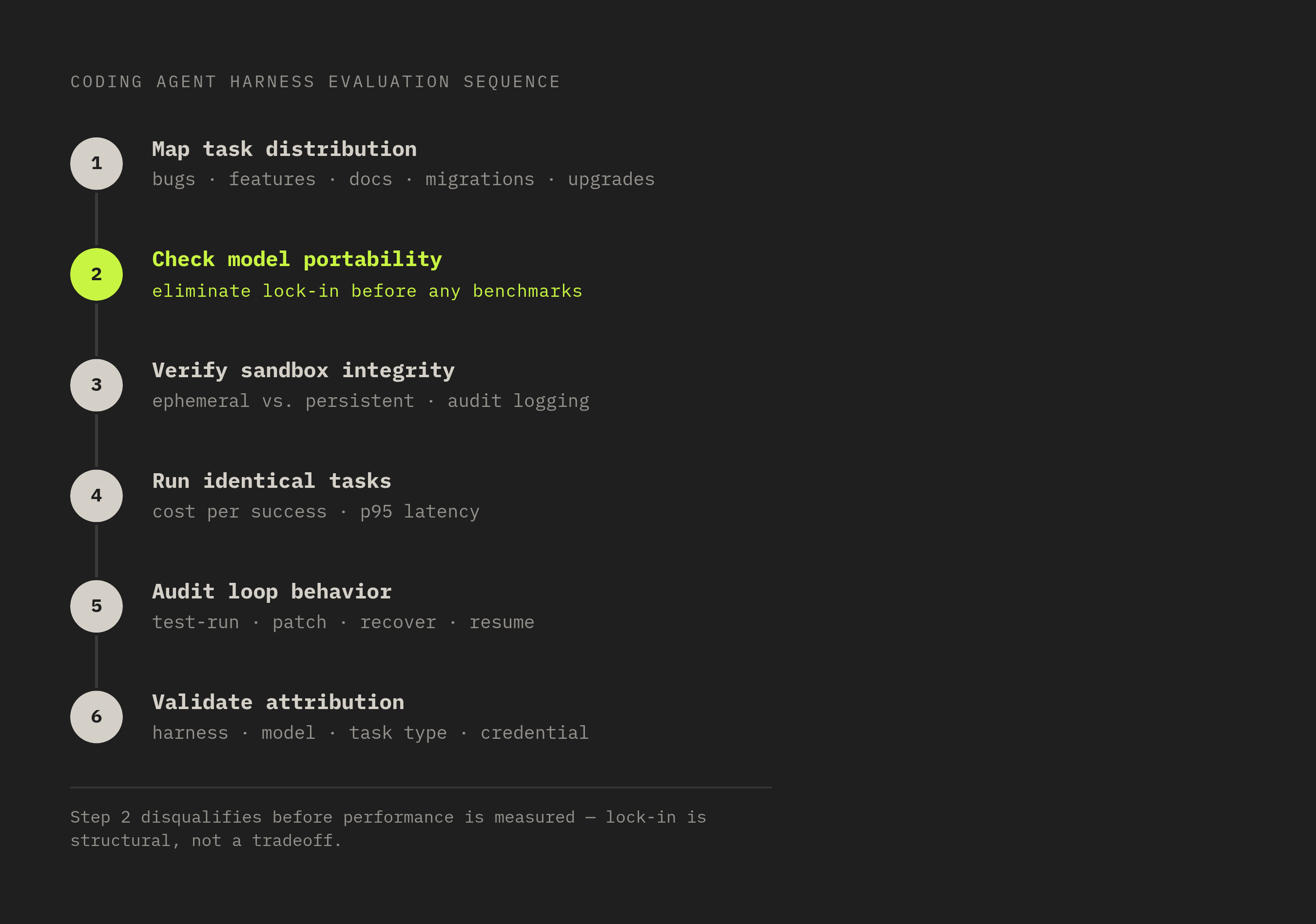
None of the five criteria above substitutes for running the work. A harness evaluation that produces an actual routing decision requires testing each candidate on the team's own tasks, under identical conditions, because the spread between harnesses across task types is wide enough that a published benchmark cannot stand in for direct measurement.
The sequence starts with mapping the task distribution: categorizing the work the team actually delegates, whether that's bug fixes, feature additions, documentation, migrations, or dependency upgrades, to know which task-fit profile matters most before anything else gets tested. Next, check model portability before running any benchmarks at all, so you eliminate harnesses that lock model selection before task performance even enters the picture, because lock-in is a structural constraint, not a tradeoff to weigh against other factors. Third, sandbox integrity requirements need to be verified against the task profile, matching ephemeral versus persistent environment needs to the kind of work being delegated and confirming that per-session isolation and audit logging meet the team's security posture. Fourth, the same tasks need to run across every candidate harness, using identical prompts on identical repositories, measuring cost per successful task and p95 latency. Fifth, loop behavior needs a specific audit: does the harness run tests before declaring a task finished, does it verify its own patches, does it recover from a failed test without thrashing, and does it resume cleanly after an interruption. Sixth, attribution needs validation before anything goes into production, confirming that every minute of agent runtime can be traced to a specific harness, model, task type, and credential.
For most teams, the result of this process is not a single winner but a routing table. Claude Code tends to take complex, multi-file feature work. Cursor tends to take fix tasks where in-editor review matters. Opencode supports more than 75 LLM providers through its integration with Models.dev, so it tends to take self-hosted workloads or situations with data-residency constraints that rule out cloud-based options. Harness and model updates ship continuously, so you need to revisit the routing table whenever a major model or harness version changes the picture underneath it.
What makes a routing table like this operationalizable at team scale is infrastructure that is itself harness-agnostic, capable of running Claude Code, Codex, Cursor, or Opencode inside isolated virtual machines, triggered from the workflows a team already uses, with attribution tracked across every run regardless of which harness executed it. With that layer in place, the routing decision becomes a configuration change rather than an infrastructure migration, which is what lets a CTO treat harness selection as the ongoing, evidence-based process this framework describes.