Opencode Agent Capabilities for Engineering Teams
Opencode's terminal-native agent takes whole tasks, not suggestions.
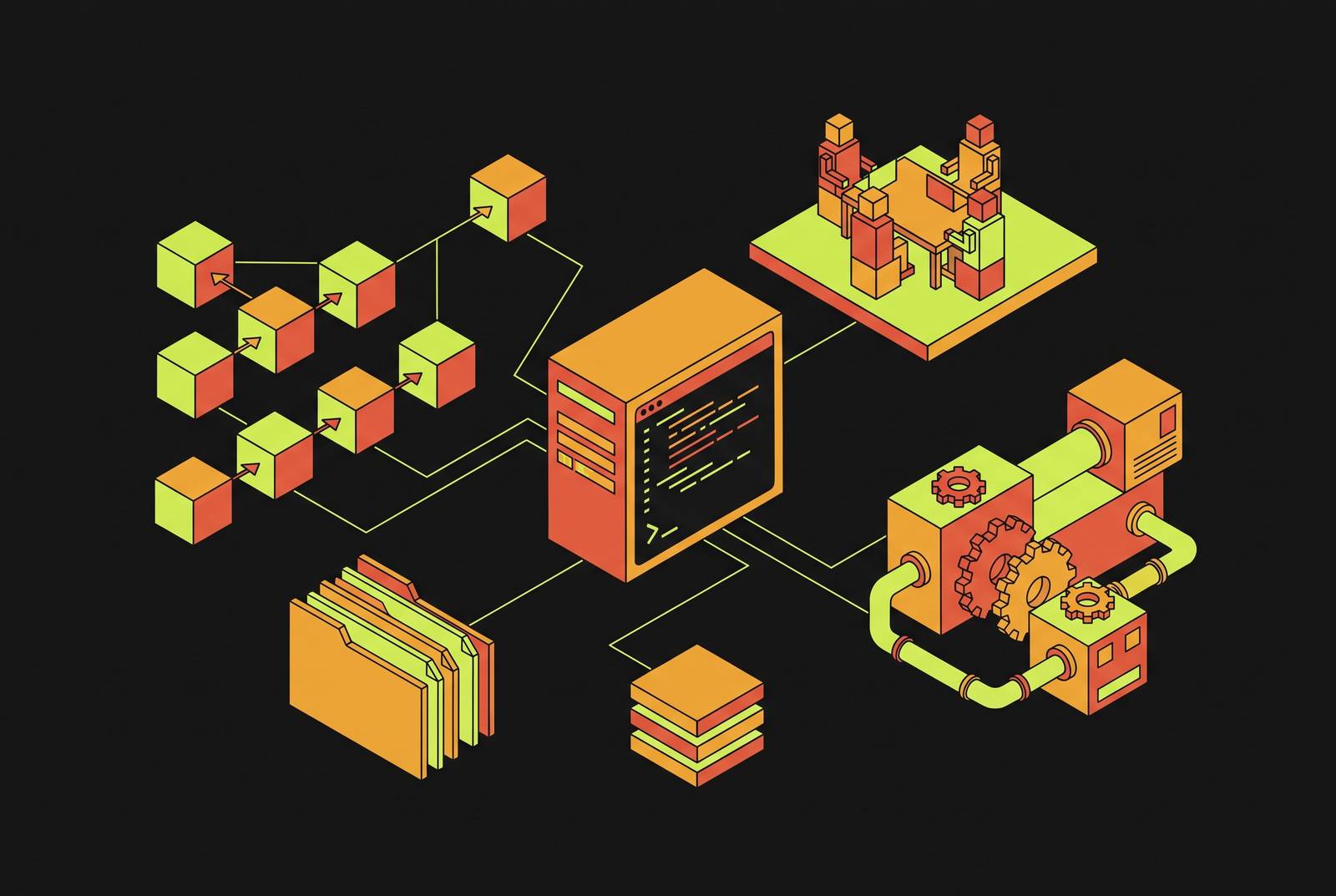
The shift underway in engineering teams has less to do with AI getting smarter and more to do with the shape of the work itself changing. Tasks that once required a human to write every line, with an assistant suggesting the next few characters, can now be handed off whole: a complete task goes in, and a finished, reviewable piece of work comes out. That category covers things like adding test coverage, upgrading a dependency across a codebase, cleaning up lint errors, running a mechanical refactor, syncing documentation to match code, or fixing a small, well-defined bug. What unites all of these is a clear endpoint: an acceptance criterion and a verifiable end state, something a reviewer can check without reconstructing the reasoning that produced it.
That verifiability changes what "review" means in practice. A task with a defined end state produces a pull request, something a human can approve or reject on its merits, rather than a suggestion that still needs a person to finish the thinking. That's a meaningful operational difference: a team isn't spending engineer time rewriting an assistant's half-formed guess, but spending it reviewing a complete attempt at a well-scoped problem. Delegation of this kind asks more of the tool doing it. Running a full reasoning loop, dispatching tool calls, executing commands, and producing an artifact that stands on its own requires a harness built for that job, not a system built to guess the next token inside a single open file.
The obvious objection is that most engineering teams already have AI built into their editors, so why would they need another layer on top of it? The answer comes down to a difference in scope. Delegated agents work across an entire repository, running the test suite, installing packages, touching multiple files in sequence, and handing back a finished result, which makes them a different job from autocomplete, one that the tool suited to one is not naturally suited to the other. A system built to delegate bounded work needs an architecture distinct from the one built to autocomplete it.
Opencode's Terminal-Native, Model-Agnostic Architecture
Opencode is an open-source coding agent that runs in a terminal, a browser, a desktop app, or an IDE, and it works against more than 75 model providers, a range that is not incidental. The design behind Opencode reflects a deliberate decision to keep the harness, the part of the system that runs the reasoning loop and executes commands, separate from both the editor a developer happens to use and the model doing the reasoning.
That separation is visible first in how models get selected. A team using Opencode points it at any model provider's API key, making the choice of model a configuration decision. Switching providers doesn't mean switching tools.
Opencode also runs in two distinct modes, toggled with a single keypress. Plan mode has the agent propose an approach before it touches a single file. Build mode is where it actually makes the changes. That split maps onto a pattern engineering teams already use without thinking about it: review the approach before the work happens, not just the output after it's done.
Opencode uses cache_control breakpoints, two to three of them for Anthropic-style providers, to avoid reprocessing the same context repeatedly, a detail about prompt caching that matters on its own terms. A fix tracked as PR #51960 removes the session ID from the cached prefix, restoring the cross-session savings the caching mechanism was meant to provide. It's a small technical point, but it illustrates something about the project: the caching architecture is being actively tuned for the realities of repeated, similar work across sessions, which is exactly the pattern bounded-task delegation produces at scale.
The terminal-native design matters for a more structural reason. A terminal gives an agent direct access to the shell, the filesystem, and the build toolchain, without an IDE acting as a go-between. That's the same surface area a delegated task actually needs to touch: running a test suite, installing a package, executing a build script, checking a diff against the working tree. An agent built to operate inside an editor's buffer has to work around the editor to reach that surface. An agent built for the terminal is already standing on it.
The six concrete capabilities Opencode gives engineering teams
Each capability Opencode offers maps onto a specific point where teams run into trouble trying to delegate coding work at scale, rather than functioning as a generic feature added for its own sake.
The first is autonomous file editing across a repository. Opencode reads, modifies, and writes files across an entire codebase within a single session, not just inside whatever buffer happens to be open. That's what makes a dependency upgrade or a repository-wide refactor something an agent can actually complete, rather than something it can only comment on from within one file at a time.
The second is the Plan and Build mode separation, which does real work here beyond convenience. Before any code changes, the agent states what it intends to do, and an engineer can intervene at that stage, before a single edit lands. That's the gate that makes autonomous file changes something a team can trust without a human re-checking every intermediate step.
The third capability is multi-agent coordination, and it goes further than most teams expect from a terminal-based tool. Opencode supports agent teams in which a lead agent spawns teammate agents, each with its own context window, coordinating through message passing. The capability that stands out most here is model mixing: Opencode lets a team assign different providers to different roles in the same team, a planner on one model, an executor on another, a verifier on a third. The same research finds that the right role assignment depends on the task domain: some workflows bottleneck at the planning stage, others at execution, and no single model configuration solves both equally well.
The fourth capability covers session memory and context management, and it comes in two layers. Natively, Opencode persists sessions: a developer can resume the last one with opencode --continue, jump to a specific one with --session <id>, fork a session with --fork, or export it as JSON or a shareable public link. What Opencode lacks natively is persistent knowledge that carries across sessions, a structured record of what was tried, what failed, what got fixed, and what got decided, queryable without replaying an entire conversation from the start. The plugin ecosystem closes that gap. The oc-mnemoria plugin gives an entire agent team a shared memory store, searchable through a combination of BM25 and semantic search, tagged by which agent role created each entry, so context survives the handoff between planning, building, asking, and reviewing.
The fifth capability is sandboxed execution through pluggable compute. Opencode's harness runs the reasoning loop and dispatches tool calls, and it stays separate from the compute layer where commands actually execute. The Daytona Sandbox Plugin takes advantage of that separation directly, running Opencode sessions inside isolated Daytona sandboxes and syncing the resulting changes back through Git branches. Research on agentic system evaluation backs up why this layer deserves attention on its own: the harness, not the model alone, determines the task completion rate, how much compute and memory a run consumes, and how the system recovers when something goes wrong. Judging an agent purely by which model sits behind it misses how much the orchestration layer around that model shapes the outcome.
The sixth capability is async cloud delegation that returns a pull request. Opencode sessions can run as background tasks and hand back their output as a branch or a completed pull request, without requiring a person to stay present for the run. This is the capability that makes Opencode valuable at team scale rather than only to an individual developer working alone: an engineer assigns a task, a PR comes back, and review happens the same way it would for a teammate's own work.
Opencode's model-agnostic design and fast-moving model performance
Model performance on any given task type keeps shifting as new models ship, and a harness tied to a single provider forces a team into a tradeoff between a stable workflow and access to whichever model is currently strongest. Opencode's architecture avoids that tradeoff by keeping the two decisions separate.
The research on heterogeneous agent teams makes the underlying logic concrete: the model best suited to a planner role and the model best suited to an executor role are often not the same model, and which one wins which role shifts by task domain. No single model dominates every role a workflow requires. Opencode's model-family prompt matrix, nine base prompts keyed by substrings in the model ID, means swapping a model into a role doesn't require reconfiguring how the harness talks to it. The harness already knows how to adapt.
For a team running a multi-agent workflow, the ability to mix providers within a single team, something a single-provider harness simply cannot do, means the best available model can be assigned to each role on its own merits, independent of what every other role is using. That flexibility comes with a governance requirement: a team needs to know, at the level of the specific model and the specific credential, which one produced which output. That attribution makes it possible to keep iterating on role assignments as real performance data builds up over time.
The natural objection here is that running multiple provider API keys and separate model configurations adds operational overhead a single-provider setup avoids. That overhead is paid once, during configuration. The cost of staying locked into an underperforming model for a task type it handles poorly keeps accumulating, sprint after sprint, for as long as the lock-in lasts.
Opencode integrations with Slack, Linear, GitHub, and GitLab
Agent delegation becomes workable at team scale when the agent gets triggered from wherever work is already tracked and sends its output back to that same place, rather than asking a team to adopt a new surface just to coordinate the work. Opencode's architecture fits this pattern without demanding a new coordination layer of its own.
One production example of this full loop comes from Warp's Wilson workflow, which takes a request made publicly in Slack, creates a corresponding Linear issue, implements the change, opens a GitHub pull request, and finishes with QA that includes computer-use verification and a proof video of the completed feature. That example illustrates the integration pattern end to end, not a claim about what Opencode itself does, but it shows what a complete delegation loop looks like when it works: a request enters through a channel a team already uses, and a reviewable result comes back through the same kind of channel.
The open-source Background Agents project, ColeMurray/background-agents, builds a version of this pattern directly. Its Linear Bot can be mentioned or assigned on an issue to kick off a coding session, post progress as it runs, and link the resulting code change once it's ready, alongside entry points for Slack, a code hosting platform, and webhooks. Git credentials inside the sandbox stay limited to the repositories tied to that specific session, and for sessions owned by a team, access stays scoped to whatever grants that team currently holds.
For Opencode specifically, this pattern applies directly because its sessions can be triggered programmatically and return pull requests as their output. A Linear issue or a Slack mention can serve as the trigger, and what comes back is a pull request ready for someone to review, the same artifact every other part of this architecture has been building toward. GitHub Actions offers one natural execution surface for an Opencode session triggered from a CI/CD pipeline, applying the same ephemeral-environment pattern already used elsewhere: reading an issue description, making the corresponding changes, running tests and linters, posting updates to the issue as it progresses, and requesting review once the work is ready.
None of this changes what Opencode solves on its own versus what still needs to be built around it. Opencode's capabilities solve part of the problem, but putting them to work at team scale runs into problems the tool doesn't solve by itself: isolated compute, attribution that holds up across sessions, and integration with the tools a team already runs. Opencode's harness can be separated from its compute layer, but a team running agents on a developer's laptop or a shared CI runner still carries the same environment contamination risk that research on agentic systems identifies, the kind of risk that isolated VMs pre-loaded with a team's dependencies are built to remove. Knowing that an agent finished a task isn't the same as knowing which model, which harness configuration, and which credential produced it, and that full picture at the level of each run is what makes it possible to keep improving how agents get assigned to work. And triggering a session from Slack or Linear, then routing the resulting pull request to the right reviewer, takes orchestration infrastructure that a team shouldn't have to build from scratch just to get the loop closed. In every version of this workflow, what comes back is the same kind of artifact: a pull request, a recording, or a reply, the reviewable result that bounded task delegation was meant to produce.