Cage Match Shared Infrastructure vs Per-Task VM Which Environment Actually Survives a Multi-Agent Sprint
Shared containers cost less, but sensitive code may need VMs.
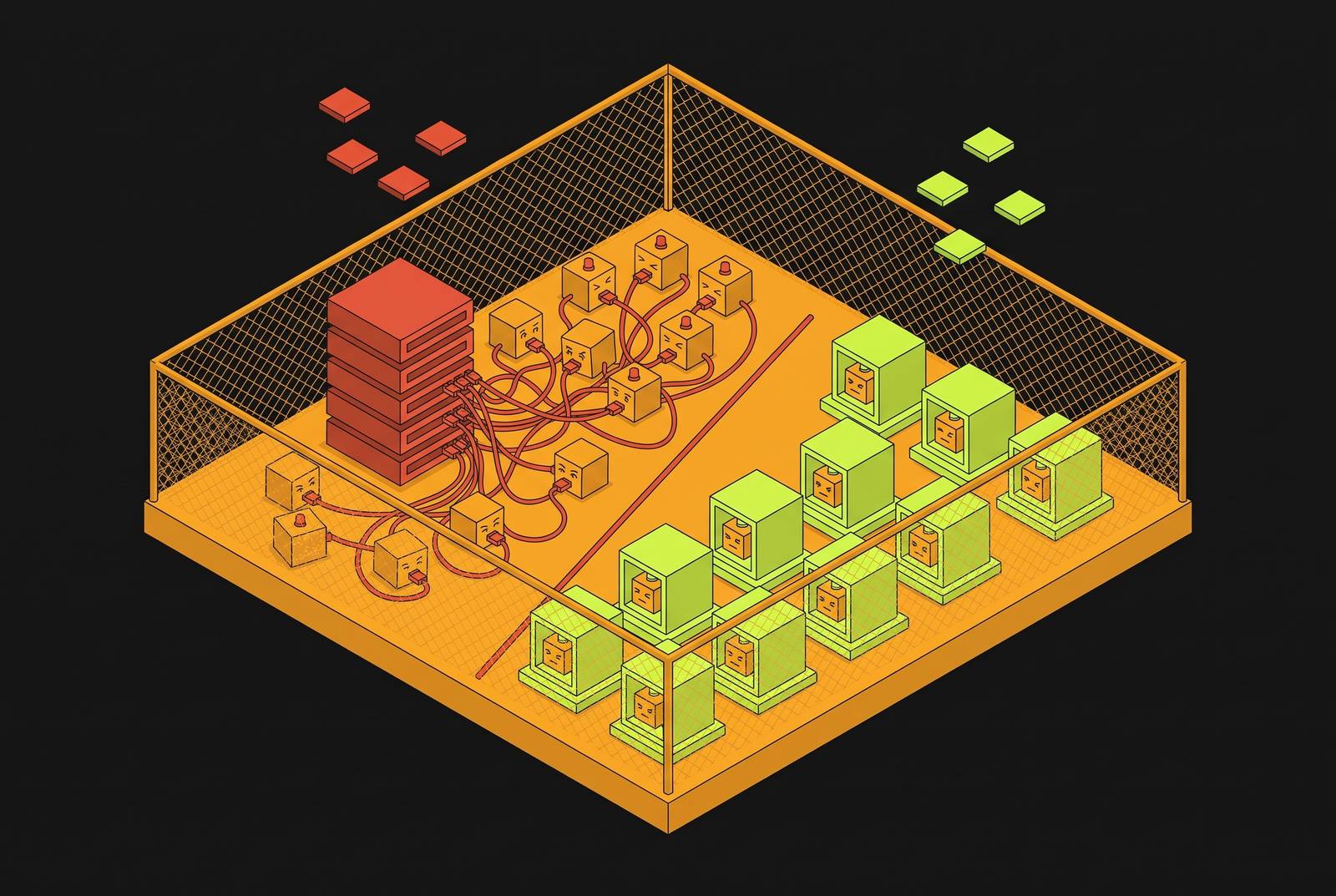
Isolated VM environments give cloud coding agents a stronger task boundary than containers that share a host kernel, but they add provisioning latency and compute costs for each task. Shared infrastructure fits more tasks on the same machines, but tasks can compete for resources at the same time and credentials can be exposed across tasks. The architecture that survives a multi-agent sprint is the one matched to the team’s failure tolerance, especially the sensitivity of the code and data its agents touch.
Why running multiple coding agents simultaneously is an infrastructure problem, not a prompt problem
Parallel coding work exposes bottlenecks in CPU, disk I/O, and memory that a single-agent run can conceal. Prompt quality cannot remove those resource constraints. The IEEE MASCOTS 2026 paper Not All AI Agents Are Equal: Characterizing Resource and Performance Dynamics distinguishes coding tasks from retrieval-augmented question answering and web search because coding requests need separate containers to preserve execution state and avoid interference. Those other workloads commonly share a container across concurrent requests. When many coding agents run at once in a sprint, the environment must keep those boundaries in place as tasks compete for resources, however capable the models are.
What shared infrastructure actually means under parallel agent load
Shared infrastructure runs several agent containers on the same nodes and uses Kubernetes resource limits, cgroups, and separate namespaces to divide the resources among them. Several tasks can occupy machines that would otherwise be dedicated to individual agents, reducing the machine count needed for the same concurrent workload. For routine development work, that economy can justify the engineering needed to manage contention. Sharing is not inherently the wrong choice.
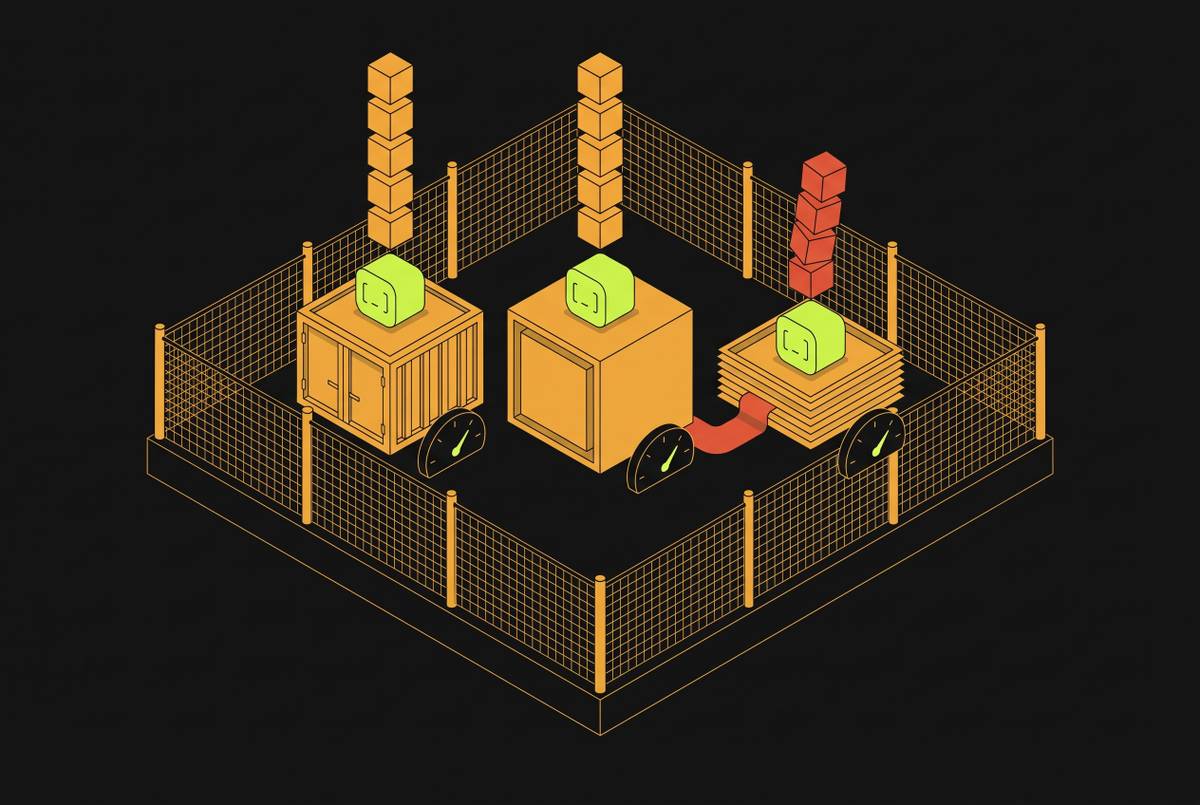
The boundary, however, is a container boundary. Agents share the host kernel, so a container escape vulnerability can potentially let one task affect others on the host. Resource interference requires no exploit at all. Without per-container I/O limits, one I/O-heavy agent can starve its neighbors, turning an individual task’s burst into a node-wide slowdown. Kubernetes placement and separate namespaces do not, by themselves, remove that noisy-neighbor failure mode.
A local container may sit idle while it waits for a remote model to respond, then need bursty CPU or a lot of resident memory when tools start to run. Reserving resources for the burst wastes capacity during the wait, while allocating for the idle period leaves too little for execution. The MASCOTS paper finds that faster model responses or more CPU cores do not always accelerate agent tasks. Adding capacity therefore cannot substitute for understanding which phase is constrained, and none of these resource controls resolves the separate exposure risk when agents handle credentials on a shared host.
What per-task VM isolation actually costs at scale
With per-task VM isolation, tasks have a hardware-enforced boundary in place of the shared kernel. That boundary has a real operating cost. Each concurrent task needs another VM, with machine overhead even when the agent uses little of its allocation. Provisioning can also recur for task launches and retries, adding latency before useful execution begins. For many short-lived tasks, setup becomes a substantial part of the work.
Cursor’s production approach assigns each background agent task its own Firecracker microVM on its own physical host, with no shared memory, kernel, or storage between tasks. This is a stronger separation than placing containers on shared nodes. MicroVMs such as Firecracker and Kata provide the minimum viable sandbox described here for production agents executing arbitrary code. A guest-kernel exploit usually stays within the VM, though demonstrated operation-forwarding attacks show that it can still cross that boundary in some configurations. Hardware isolation is not a claim of invulnerability.
Snapshotting changes the provisioning side of this trade-off. E2B’s documentation describes Sandbox.fork() as capturing a running sandbox’s filesystem and memory state, then starting independent copies that diverge from that snapshot. This allows speculative execution without having to rebuild every environment from the start. Perplexity SPACE achieves median sandbox creation at 60ms with rolling snapshots. Millisecond creation or resume times weaken the cold-start argument against isolation, but they do not erase the compute overhead of maintaining a separate VM for each concurrent task.
How a multi-agent sprint actually stresses each architecture differently
The MASCOTS paper shows that CPU-aware tool admission and task-aware CPU allocation improve latency for CPU-sensitive coding tasks, and task-aware scheduling lowers average latency across concurrent work. The scheduling layer does actual performance work. Without appropriate controls, a shared node lets one task’s demand interfere with other tasks running there. Its useful capacity depends on when tools execute and what they consume.
That produces a lateral failure pattern on shared infrastructure. An I/O burst without per-container limits can degrade neighboring agents simultaneously, while overlapping CPU demands expose the need for admission control. Dedicated per-task environments instead accumulate their own setup costs. When provisioning recurs, a sprint made up of many short tasks and retries pays that cost more often than one made up of fewer long-running tasks. The comparison is therefore between interference across work and overhead within each task.
KTH Royal Institute of Technology’s Taking Tokenization off the Host for Agentic LLM Serving identifies another shared bottleneck through its GRAPHTOK system. Coding-agent sessions serve 95.7% of input tokens from the prefix cache, yet requests still require tokenization before that cache can be consulted. After a cache hit, CPU tokenization rises to roughly half to two-thirds of median time-to-first-token. A shared frontend that cannot tokenize fast enough limits how many GPUs it can feed, even if individual task environments have adequate resources.
This distinction also limits what per-task VMs can promise. Task isolation sets the execution boundary, while the tokenizer finding applies to the shared model-serving frontend. Carnegie Mellon University’s cua-speedrun benchmark finds that faster environment I/O can make some models take longer to finish. Because that benchmark concerns computer-use agents, it is evidence of interaction between harness behavior and environment latency in those tasks.
Why the failure mode that matters most depends on what the agents are touching
Task sensitivity changes the acceptable boundary more decisively than agent count. Shared machines with container isolation can work well for tasks such as writing a test, fixing a lint error, or updating documentation. Payments services, authentication code, and credentials demand stronger separation. The consequences of exposure set the isolation requirement. A small change involving a production secret can require more isolation than a large documentation update.
Developers copy production database queries, API responses, or system logs into coding environments, where an agent may read them as part of its task. On a shared node, that context increases the consequences of a lateral breach. The shared-host boundary must be evaluated against the data actually present.
Outbound data flows from cloud agents can conflict with FedRAMP High, HIPAA, and PCI-DSS requirements, while the EU AI Act adds data and model lineage, logging, and audit obligations for providers and deployers of high-risk AI systems. These conditions indicate potential legal risk for an architecture. A VM alone cannot control where data goes. Cognition’s Devin Outposts separates execution from orchestration by placing commands, file edits, and repository access on customer-operated hardware while inference and planning remain in Devin Cloud.
Outposts supports customer hardware including workstations, Kubernetes clusters, and Apple Silicon Macs, offering a data-residency approach without necessarily adopting dedicated per-task machines throughout. For teams with mixed workloads, a hybrid architecture can similarly route routine work to shared containers and sensitive work to isolated environments. Teams must keep checking how tasks are classified as the tasks and their context change. The routing rule belongs in the platform.
What the review queue looks like when the environment survives but the team doesn't scale with it
LinearB reports that agentic and AI-assisted pull requests wait longer for someone to pick them up than unassisted pull requests, though AI-assisted changes can clear faster once review starts. Neither shared nodes nor isolated VMs create that attention. The operational implication is to treat execution capacity and review capacity as co-dependencies, rather than declaring the sprint successful because every agent returned a pull request.
How to match environment architecture to a team's actual failure tolerance
The first decision is what the agent can access. For production secrets, regulated data, or payment systems, the minimum viable boundary is a microVM. Routine development tasks can stay on shared infrastructure if the team accepts the risks of contention and exposure that come with it. The platform needs routing logic that applies the boundary to the task and its context.
The second decision concerns concurrency and task lifetime. High-volume, short-lived work accumulates provisioning overhead quickly, so snapshot-based startup changes the economics of per-task isolation. Modern sandbox tooling can provision in sub-150ms, reducing but not eliminating that cost. The third decision is whether correlated degradation is tolerable. A team that can accept one noisy neighbor slowing several agents has different options from one that requires execution failures to remain confined to individual tasks.
Teams that want parallel work without shared-host credential exposure can start with isolated cloud VMs in place of developer laptops or shared nodes. Work can continue when laptops close, and each task’s environment is disposable. Event-driven dispatch makes that posture operationally manageable. A Slack mention, Linear ticket, GitHub issue, or Sentry alert can trigger an agent in its own environment and return a pull request. That pull request is the reviewable artifact, with a human review gate before any merge.
The environment should also remain independent of the harness. Teams should be able to switch among Claude Code, Codex, Cursor, and OpenCode without redesigning the execution architecture. For production use, this separates the choice of agent from the controls governing its access, including ephemeral per-task credentials. Governance belongs in the platform. SCIM, audit logs, human review gates, and SOC 2 controls need to work the same way whichever harness does the task.
Bring-your-own model accounts keep model charges with the team’s subscriptions rather than adding a platform markup, while per-workspace-minute pricing ties compute charges to workspace use. Platforms combining isolated Linux VMs, multiple harnesses, and integrations with existing work systems can spare teams from building the isolation layer themselves. Pricing does not replace workload classification, however. The durable choice is a platform that can enforce different boundaries for different tasks while making each boundary’s resource cost and failure risk explicit.