Isolation Cage Match Scoring Per-Task VM Runners on the Metrics Engineers Actually Argue About
Startup, isolation, parallelism, and audit tradeoffs decide which agent runner fits.
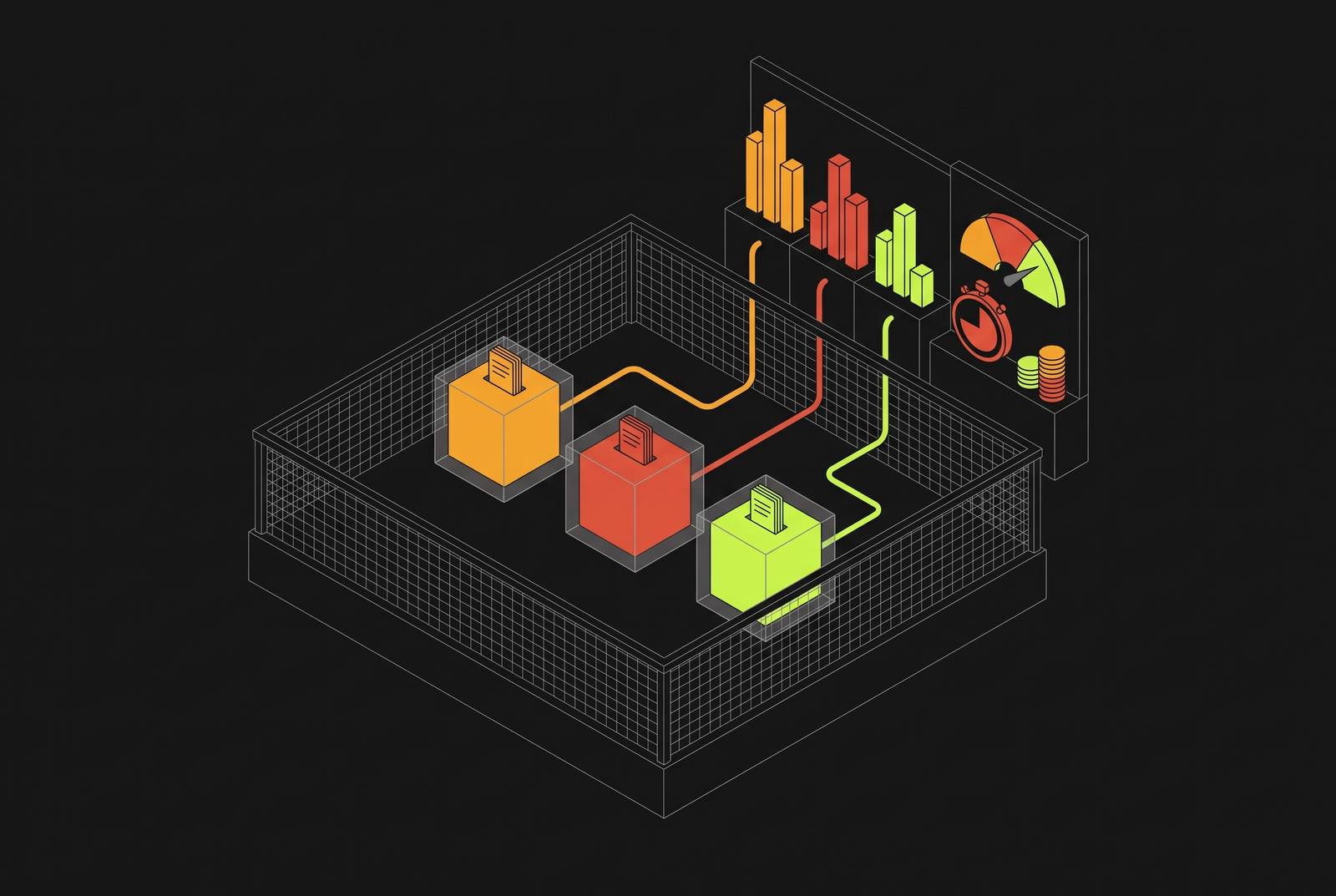
A bring-your-own API key cloud coding agent runner needs more than support for a model provider’s API key. For teams seeking to run Claude Code or Codex in the cloud without managing infrastructure, the decisive comparison is startup latency, isolation strength, parallelism, auditability, cost per task, and security blast radius. Those tradeoffs decide whether a runner helps ship more pull requests or just runs more environments.
Why choosing a cloud coding agent runner is an engineering decision, not a marketing one
Concurrent agents need separate working state before they need sophisticated orchestration. When two tasks operate against the same working directory, the failure can be silently wrong code without a crash. Separate tasks therefore need a defined boundary. Engineers must determine where that boundary sits and which resources remain shared across it.
The three patterns are a dedicated VM per task, a container per task, and a git worktree on shared infrastructure. Cursor’s Cloud Agent uses an Ubuntu VM per task as of July 2026, while Devin gives each managed sub-task an isolated VM with its own terminal and browser. Containers put process and filesystem boundaries in place while sharing the host kernel. Worktrees separate checkouts and branches without creating a separate execution environment.
Product descriptions do not always fit neatly into those categories. Codex Cloud describes isolated workspaces cloned from a published environment, a prepared filesystem snapshot, while also describing per-task VMs and recoverable task state. Its workspace lifecycle is therefore useful evidence, but “workspace” alone does not identify the underlying security boundary. Claude Code’s native --worktree support, shipped in version 2.1.49 on February 20, 2026, uses the shared-host pattern.
Startup latency and what it costs when agents wait to begin
Startup latency consumes time before an agent can work. Across concurrent tasks, that launch delay becomes part of the operating cost of parallelism. A fresh VM requires provisioning, repository cloning, and dependency installation before useful execution begins. AQ’s workspace docs describe dedicated VM provisioning as “slowest and most expensive to provision.”
Containers occupy the faster middle position because starting a container does not require provisioning a full VM for each task. Worktrees are fastest to create because they add another checkout of the same git object database without a new kernel or container runtime. That advantage comes from omitting an execution boundary.
However, VM isolation does not prescribe one startup experience. AWS Lambda MicroVMs offer near-instant launch and resume with VM-level isolation for uses including AI coding assistants and agent sandboxes. Their design accommodates state across multi-step tasks without infrastructure management overhead. This creates a different design point from provisioning a fresh full VM for every task.
Lifecycle design consequently belongs in the latency score. Slow initialization favors persistent workspaces that amortize setup across a long task, while fast launch and resume reduce the penalty of task-scoped environments. A comparison that measures only first launch misses this distinction.
Isolation strength and what a weaker boundary actually lets through
The speed advantage of a worktree has a corresponding security limitation. Its branch and filesystem separation does not separate CPU, memory, ports, databases, or credentials available on the host. An agent that misbehaves or is prompt-injected can thus change state outside its own checkout. Branch separation is not an execution-security boundary.
Containers provide a real process and filesystem boundary, but their shared kernel remains a common point of exposure. Mohammadreza Rashidi’s 2026 study documents a disclosed, patched runc container-escape CVE affecting runtimes used by agent sandboxes. The vulnerability establishes that the residual risk of kernel sharing is concrete.
VMs provide the strongest boundary of the three patterns by separating each task’s kernel, memory space, and disk state. Under that boundary, a runaway process or malicious payload is contained within the task VM, separate from the host execution environment. This distinction is especially significant for model-generated shell commands. When few people check the agent’s work, prompt injection in a ticket or file summary can lead it to run commands without permission.
The same study brings together 39 papers from 2023–2026 and finds gaps that keep a security ranking for all systems from counting as a measured benchmark. Isolation architectures and capability models are rarely evaluated together, enforcement assumes an honest policy author, and benign but out-of-scope actions remain insufficiently addressed. AWS Lambda MicroVMs address a specific exposure by separating generated code from the agent’s runtime. That boundary prevents the code from reaching the agent’s own credentials and memory.
Parallelism ceiling and why isolation model determines how many agents can run at once
Stronger execution boundaries also change the resources required for concurrency. A dedicated VM adds per-task provisioning overhead, so a fixed budget constrains how many isolated tasks can run simultaneously. Containers reduce that overhead and support greater density, but retain the shared-kernel risk. The parallelism score therefore cannot be separated from the isolation score.
Worktrees avoid much of the provisioning cost, but they do not create additional host capacity. Their tasks compete for CPU, memory, ports, and test infrastructure. More checkouts do not mean more execution resources. As concurrency grows, contention can degrade each task’s performance and increase interference between tests.
This produces two different limits that a headline concurrency figure can conceal. A VM-based runner may run out of budget or resources while keeping tasks separate, while a worktree-based setup may take on more tasks that then slow down on the shared host. Containers sit between those patterns in provisioning overhead, with a different security tradeoff.
There is also a downstream constraint on useful concurrency. Each parallel agent can produce a pull request that a person must judge, while adding room for more agents does not give reviewers more time. Unconstrained execution can therefore shift the queue from agents waiting to start to changes waiting for review. Auditability determines how difficult that second queue becomes to clear.
Auditability and the review queue problem parallelism creates
A diff shows what changed, but not necessarily why. When many agents finish together, reviewers must piece together enough context to judge each change, understand how it was tested, and decide whether it belongs in the repository. A runner that exposes only the final patch leaves much of that reconstruction to the reviewer. Faster execution does not remove this work.
Cursor Cloud Agents attach a screen recording of the VM session, screenshots, and logs to each pull request. The recording demonstrates the built software in a browser, giving the reviewer evidence beyond the diff. These artifacts make the task’s execution more legible. They support a human decision rather than replacing it with the fact that an agent completed its run.
Auditability also depends on access before completion. AQ’s docs identify the active stage, when the agent is running, as the stage a reviewer can meaningfully watch. Visible, shareable workspaces give reviewers an opportunity to intervene while work is underway. This is a different capability from inspecting a finished patch after the execution environment has disappeared.
Ephemeral environments make the timing of evidence capture consequential. Codex Cloud preserves files, including uncommitted changes, and makes saved task state recoverable for up to seven days after the last turn. Recovery is not permanent retention. The audit trail must be captured before teardown or expiry to provide a durable record of what happened.
Cost per task and why the billing model matters as much as the resource model
The financial comparison begins with what triggers a charge. Persistent VMs billed while agents are working or sleeping have a different cost structure from environments billed only for active compute. In an ephemeral-per-task model, compute cost follows task count and duration, while destroyed environments incur no idle compute time. Each new task still has its own provisioning overhead.
A full VM can be expensive to provision, while a persistent environment can spread setup cost across a longer task. But paying for a sleeping VM can eat up those savings.
Codex Cloud illustrates why lifecycle details belong in the assessment even without a quoted price. Its prepared environment is tested before publication, and a task can be reopened from another device with its files and uncommitted changes intact. Saved state remains recoverable for the stated period. Those capabilities describe continuity of work, but do not by themselves establish whether retained state is billed like active execution.
Cost per shipped pull request is the unit to use. A low seat price does not establish low delivery cost if tasks spend time provisioning, contend for resources, or create work that reviewers cannot readily approve. Equally, a more expensive isolation boundary can be appropriate when the workload requires it. The comparison should connect billing to completed, accepted work rather than treating either seat price or VM count as the result.
Security blast radius and what happens when an isolated task goes wrong
Isolation strength asks how well the execution boundary holds. Blast radius asks what the task can reach, including through access that the boundary is set up to allow. An isolated VM with production database credentials or write access to the main branch can still cause damage outside its own disk and memory. Strong containment does not neutralize broad authority.
Cursor Cloud Agents work on a new branch created from the target branch, leaving the main branch and other feature branches untouched until a human merges. That workflow limits where an agent’s code changes take effect. It complements VM isolation because repository authority and execution containment address different failure paths.
Rashidi identifies network egress control as a distinct execution-security mechanism, separating an agent that can contact arbitrary endpoints from one restricted by an allowlist. Prompt injection can make use of any credentials and destinations the agent can still reach. The same study identifies time-of-check-to-time-of-use races, in which a valid state check becomes stale before the agent acts, as an underaddressed risk for shared writable systems.
Sending context, including logs or query results that contain sensitive data, to external model providers can put compliance with frameworks such as HIPAA at risk. Self-hosting execution keeps that environment within the enterprise perimeter, but does not eliminate prompt injection against internal filesystems or CI/CD access. Isolation model, credential scoping, branch protection, egress policy, and audit controls must therefore be evaluated together.
Scoring the three patterns across all six dimensions
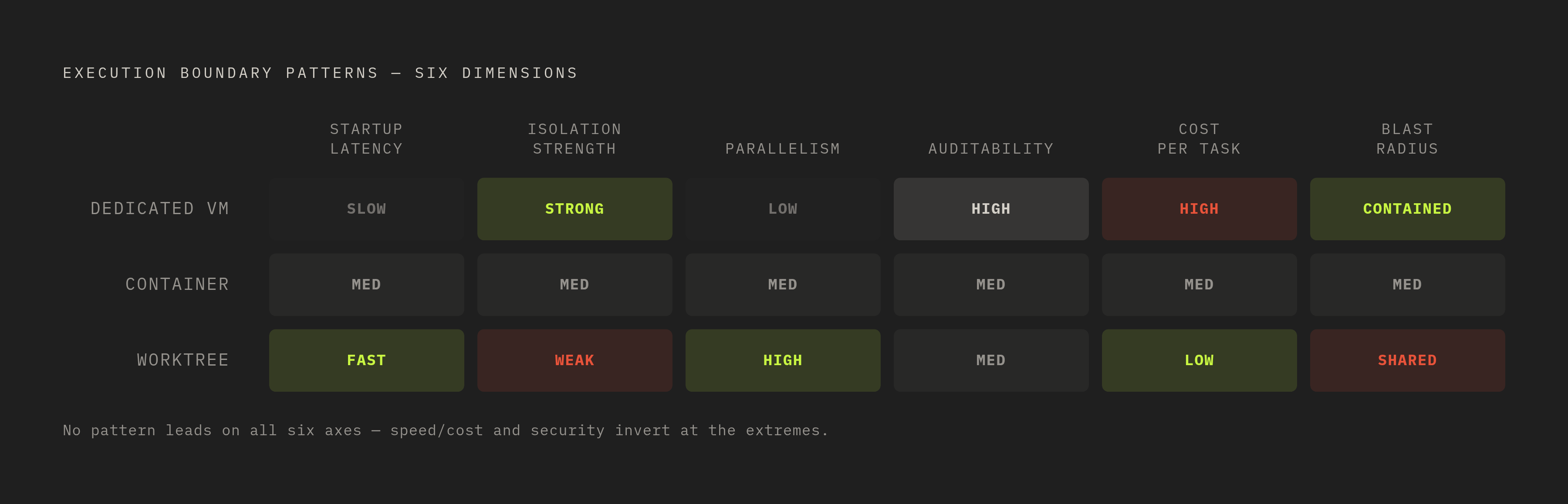
Dedicated VMs rank strongest on execution isolation and containment of local task failures. Fresh full-VM provisioning ranks weakest on startup latency and provisioning expense, while its per-task overhead limits concurrency on a fixed budget. Auditability remains a platform capability. Recordings and logs must survive the environment if they are to support later review.
That profile best fits workloads where isolation failure would have severe consequences, including regulated data, production credentials, and unattended overnight runs. The qualification is essential here. Production credentials can still cause harm in a VM, so the blast-radius controls described above are still needed. This pattern is most suitable when review capacity can bound parallelism without infrastructure cost preventing the required workload.
Containers occupy the middle position on startup speed, resource cost, and isolation strength. They are a fit for high-volume, low-sensitivity work such as dependency bumps, lint sweeps, and test coverage, where throughput and cost take priority over maximum separation. Their residual kernel-sharing risk remains part of that choice. As with VMs, auditability depends on the runner’s evidence capture and workspace lifecycle.
Worktrees rank best on creation speed and provisioning cost, but weakest on execution isolation and shared-host containment. Their parallelism is constrained by resource contention, and stale worktree accumulation creates an additional operational burden. They best fit a single developer running sequential local tasks with an accepted shared-host risk. Their cheap creation does not remove cleanup or review work.
The evaluation method is to score each candidate on all six dimensions, then weight those scores by the workload’s requirements. No pattern wins on every axis. A runner earns its place when its combination of boundaries and operating controls helps the team turn agent execution into reviewed, shipped pull requests.