Cage Match Which Managed Cloud Platforms Close the Loop From Agent Task Assignment to Returned Pull Request
Seven agent platforms compared on how much of the loop each closes.
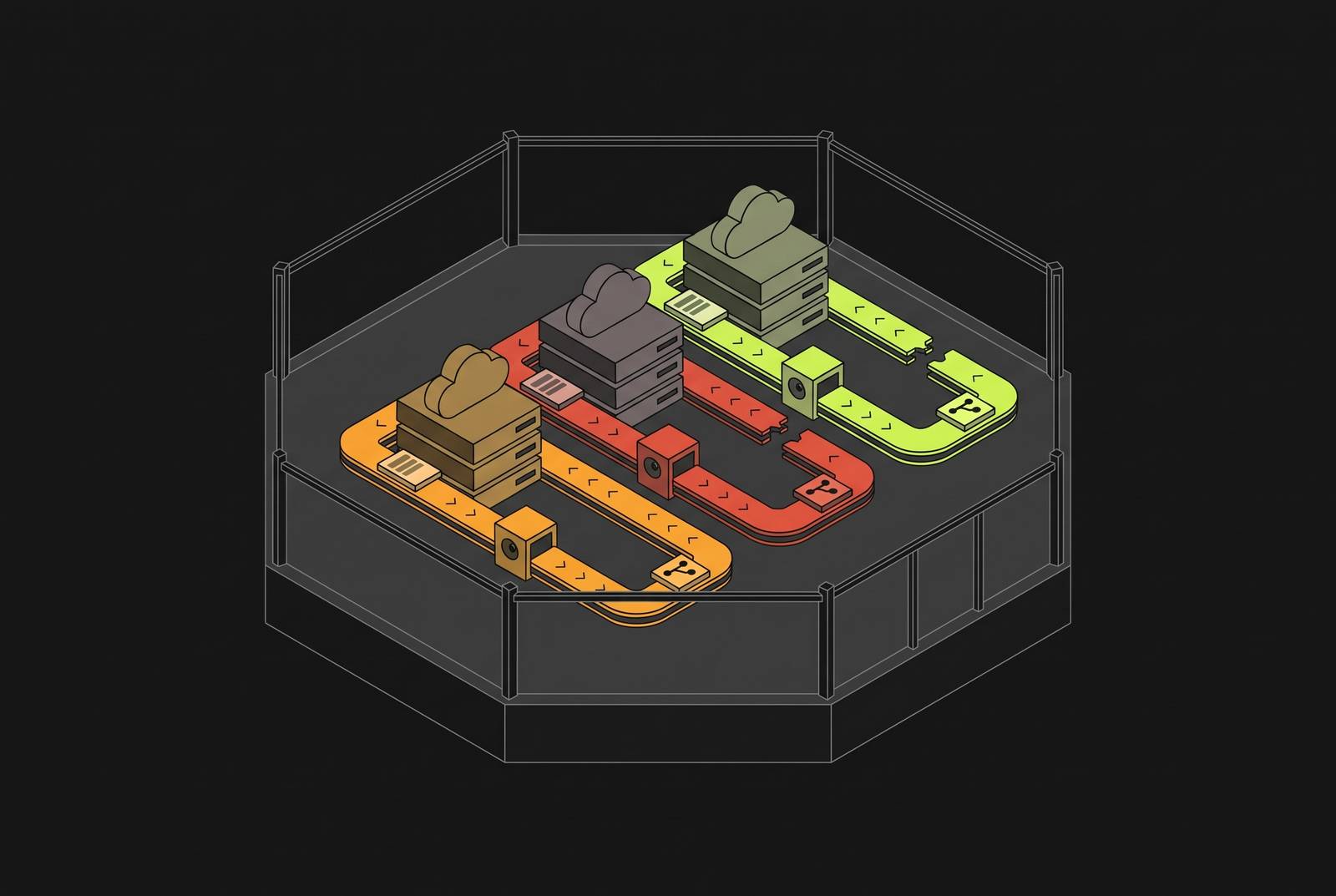
Claude Code can run in the cloud through cloud sessions, while Team and Enterprise plans also offer routing to self-hosted environments on customer servers. For teams seeking managed agentic coding without infrastructure work, the decisive comparison is the full workflow, including hosted execution.
Why the full loop — task in, PR out — is the right unit of comparison
Most major platforms can now turn a ticket into a pull request while nobody is watching. Typing speed is no longer the central constraint. The platform must also connect that work to the team’s existing intake, security policies, verification process, and review workflow. A product that handles execution well but leaves review evidence inaccessible shifts engineering work.
Feature counts obscure that division of responsibility because an integration does not establish how much of a workflow it completes. The unit of comparison must therefore include the handoffs. The five links are task intake, environment provisioning, agent execution, PR creation and evidence, and review handoff. Together, they cover how work arrives, where it runs, how it is tested, what the agent returns, and how a person requests changes or merges.
What "isolated environment" actually means across these platforms, and why it determines security posture
Isolation describes a boundary. An ephemeral sandbox, an isolated VM, and a worker on customer infrastructure can all separate agent work from a developer’s laptop. They do not necessarily impose the same restrictions on network access or credentials. Where code runs determines one part of the exposure, while what the agent can reach determines another.
Code-touching processes can run on customer infrastructure while orchestration and inference remain in a vendor’s cloud. That distinction needs to survive procurement discussions. It prevents a deployment option from being mistaken for a promise that every part of the workflow remains within the customer’s boundary.
Network access creates a separate tradeoff between containment and flexibility. OpenAI Codex cloud allows network access during setup but disables it by default during the agent phase, with configurable exceptions. Under that default, a missing package cannot be fetched mid-task. Credentials require equally explicit governance because an agent opening a PR acts as a non-human identity. Audit trails need to attribute each task to its source, person, harness, model, and credential.
How each major platform covers the five links: a platform-by-platform assessment
GitHub Copilot coding agent uses an ephemeral GitHub Actions-powered sandbox for its Actions-based sessions. Issues provide task intake, and multiple tasks can run concurrently without competing for local resources. Each gets its own environment, branch, and PR. Actions-based tasks have a 59-minute runtime limit and cover one repository and one PR, although cloud sandbox sessions can work across repositories. At the review boundary, human approval is required before CI/CD workflows run, with branch protections remaining in force.
Google Jules provides a managed coding workflow with intake through its UI or public API, which teams can use to connect CI/CD pipelines, Slack, and Linear. Its defining checkpoint precedes execution. The developer can review and edit the execution plan before the agent writes code. Jules then executes the plan and opens a pull request, with automatic detection and repair of CI failures on PRs it created. The plan gives developers a chance to approve work that a fire-and-forget workflow lacks, but they still need to review the change it produces.
Codex cloud has separate phases for environment setup and agent execution, and internet access is off by default while the agent runs. Tasks arrive through the web interface, IDE extension, or an @codex tag on a GitHub issue or pull request. Its task scope is one repository. The offline default restricts mid-task dependency fetching unless network access is enabled. After execution, the team can request revisions, open a PR, or pull the diff locally, so task completion and PR creation are distinct steps.
Claude Code has cloud sessions, and Team and Enterprise can also route work to self-hosted environments. The supplied details establish session-based work but not a complete intake matrix. Multiple sessions can run in parallel, sharing rate limits with other Claude usage rather than incurring a separate platform-level compute charge. After a push, the conversation remains available for diff inspection, inline comments, PR creation, or another change request. With the Claude GitHub App installed, a cloud session can watch a PR and respond to CI failures and review comments.
Cursor cloud agents can run through managed execution or on self-hosted workers announced in March 2026. The latter keep code-touching processes on customer infrastructure while orchestration and inference remain in Cursor’s cloud. Intake can begin from the editor, browser, or phone. Agents support GitHub Cloud and Enterprise Server, GitLab Cloud and Self-Hosted, Bitbucket Cloud, and Azure DevOps, or can start without a repository through “Start from scratch.” The agent works on its own branch and opens a PR, while Bugbot provides automated review as a separate layer.
Devin provides a managed environment for planning, implementation, testing, and review, with direct assignment or an @-mention in Slack as intake. As of March 2026, it can split large tasks across parallel agents in isolated VMs. It opens PRs and responds to review comments and CI results. That supports longer delegated workflows. The tradeoff is intermediate visibility, since a long autonomous task is harder to monitor while it is underway than a workflow with an explicit pre-execution checkpoint.
Amazon Bedrock AgentCore offers the fully in-account path for teams requiring execution within their own AWS account. The team owns more orchestration work. Its described PR workflow pushes an agent/<taskId> branch and records the verification command, exit code, and attempts used. The PR opens as a draft unless verification passed, and the agent never merges. This makes the evidence and review boundary explicit without establishing a managed intake path for every source of work.
Where the loops break: the hand-off points teams most often have to wire themselves
Task intake and review handoff are frequent breakpoints. A platform may take tasks without trouble but still make engineers move work from Linear tickets, Slack threads, or production alerts into its own interface. An API makes a connection possible, but does not mean that connection is already built. Teams need to establish who owns the routing between the source of work and the agent.
Repository scope introduces another seam in the workflow. A task spanning services may need to be split and sequenced if the chosen execution surface supports only one repository. Product names alone are insufficient here. Copilot’s Actions-based sessions and cloud sandbox sessions differ in repository scope, so teams must check which one they will buy and use.
The returned PR can hide unfinished work too. Without test output, a verification record, or relevant browser evidence, reviewers must reconstruct what the agent attempted before judging the change. AgentCore’s recorded command, exit code, and attempts illustrate a more explicit handoff. Similarly, a workflow that only starts through human interaction does not establish support for scheduled or event-driven work, even if its execution stage is otherwise unattended.
Automated PR review, production alert triage, and other loops that close without human initiation
Automation changes the first link from an instruction to a signal. A CI failure or new PR can start a bounded workflow without someone opening a session. Jules repairs CI failures on PRs it created, while Bugbot reviews PRs as a separate layer. These are different responsibilities. Repair changes the proposed code, whereas review evaluates it, so neither capability alone establishes an end-to-end production triage loop.
A scheduled production-alert workflow makes the distinction concrete. It reads logs, diagnoses errors against the codebase, and returns a PR, a filed task, or an all-clear. The timer supplies intake, but the remaining links still need repository access, an execution environment, and an actionable result. Scheduling is only the trigger. The full loop closes when the output reaches a person who can decide what happens next.
The governing rule is to propose. A PR, filed task, or Slack summary presents work for human action, while a merge, deployment, closed ticket, or customer message changes operational state. Those actions stay with a person. This boundary permits unattended investigation and preparation without treating successful agent execution as permission to ship.
Pricing structures and what they mean for the cost of a closed loop at scale
Cost depends on the billing unit, how complex the tasks are, and how many tasks run. Copilot uses seat-based pricing across Pro, Business, and Enterprise, while Codex cloud is token-metered and included with ChatGPT Plus. Jules has a free base tier and paid Pro tier. These structures expose teams to different costs even when the assigned work looks similar.
Devin’s restructured tier model replaced per-ACU pricing, with team-level and per-seat charges in Teams and custom Enterprise pricing. An unclear task can use a lot of capacity without yielding a PR that can be merged, and follow-up work still needs attention. For budgeting, the useful comparison is cost per accepted PR, including subscription or seat charges, failed tasks, revisions, and reviewer time.
Enterprise security and governance requirements, and how each platform meets them
A coding agent with production-repository access is a privileged non-human identity. The requirements include SOC 2 Type II certification, SAML SSO, SCIM provisioning, administrative policy controls, and contractual support commitments. Training-data policies need a clear way to keep code out of training data, and teams may need a private cloud environment or self-hosted path to run the service where they need it. Audit attribution for each task links these controls to what the agent does.
Cursor’s self-hosted workers and Claude Code’s Team and Enterprise routing let teams run work on customer infrastructure, while AgentCore has fully in-account execution. Copilot inherits the Actions environment model and preserves the human approval boundary before CI/CD workflows run. Codex’s default-offline agent phase limits what the agent can reach over the network. None of these facts, by itself, establishes that a product satisfies the entire enterprise checklist, and the supplied material does not establish certification and provisioning coverage for every platform.
The Sentry and GitHub Copilot worked example needs environment secrets, a custom agent profile with MCP server configuration, and a way to install private packages without exposing credentials that grant broad access across the organization. Those steps require explicit team configuration. Governance therefore requires considering not merely whether an agent can access a repository, but whether its required access can be granted and attributed without inheriting a person’s wider permissions.
How to choose a platform to run Claude Code or other coding agents in the cloud
The evaluation should begin with the links the team cannot easily build. If policy requires execution on customer infrastructure, the relevant paths here are AgentCore, Cursor’s self-hosted workers, and Claude Code’s self-hosted routing for Team and Enterprise. Their boundaries differ. The choice must distinguish fully in-account execution from customer-hosted code processes with cloud orchestration, rather than treating all three as interchangeable deployment options.
Does the work cross repositories, run on a schedule, or begin with production events? Those questions need answers for the specific hosted surface. Teams also need to check whether verification commands, test output, and browser evidence are available where reviewers need them. A generated PR is not sufficient if the reviewer must recreate the investigation.
Finally, harness choice determines how tightly the workflow is coupled to one agent ecosystem. A team that plans to keep one harness may accept that coupling, while a team that expects to switch needs the boundaries of its environment and workflow to stay the same. The durable architecture treats the agent as replaceable, supports the team’s own model accounts, and preserves intake and review when the harness changes. Control of the full loop requires the team to retain control of how its links connect.